Reducing Delivery Cost in Australia: The Role of Routes, Reports, and Driver Workflows
Delivery costs are shaped by more than distance. This guide explains how Australian teams can control avoidable costs by improving route plans, driver workflows and performance reviews.
 Mohammad AlavitabarCEO @ Rouptimize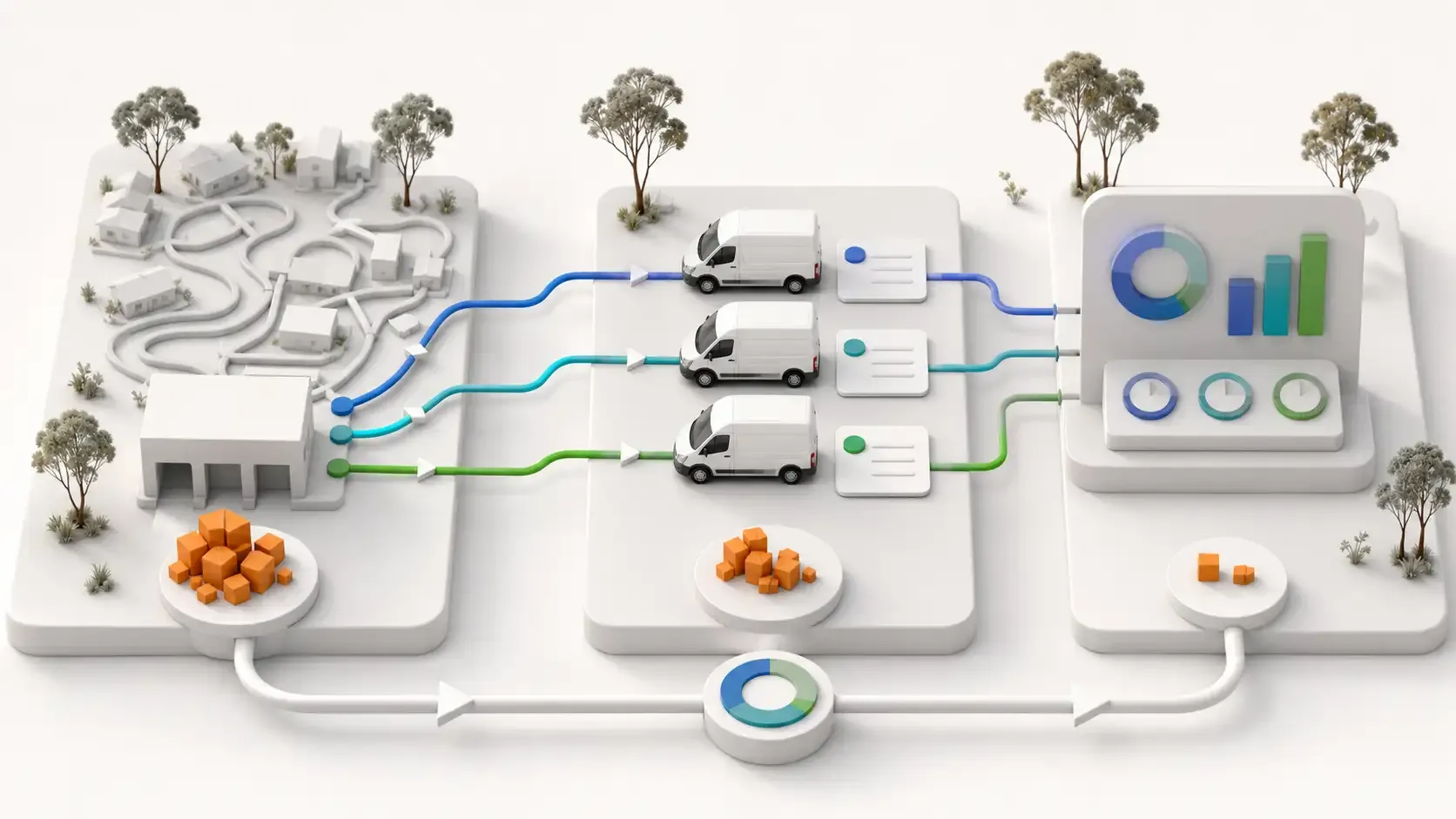
On this page
Delivery cost rarely comes from one obvious source.
It develops across the entire operating day: the time spent preparing routes, kilometres driven, vehicle capacity left unused, delays between dispatch and the first stop, failed deliveries, repeated driver calls and decisions made without reliable performance data.
This is why reducing delivery costs in Australia requires more than finding a shorter route. Delivery teams need to connect planning, driver execution and operational reporting.
The objective is not to chase a fixed savings percentage. It is to identify avoidable cost, measure it consistently and improve the decisions that create the next delivery plan.
Start by Understanding the Full Delivery Cost
Fuel and vehicle distance are visible costs, but they are not the entire cost of delivery.
A useful operational cost model should consider:
- dispatcher planning time;
- driver working time;
- total vehicle distance;
- route duration;
- number of vehicles used;
- vehicle capacity utilisation;
- failed or incomplete missions;
- repeated delivery attempts;
- customer service and coordination work;
- overtime or extended working hours; and
- administrative effort after delivery.
A route that saves a few kilometres but creates more driver waiting time may not reduce the total cost. A plan using fewer vehicles may also become expensive if it creates unrealistic workloads and late deliveries.
Cost control depends on understanding how the different parts of the operation affect one another.
Route Planning Is the First Cost Lever
The route plan determines how missions, vehicles and driver time will be used.
Manual planning often begins with addresses and visual proximity. Dispatchers group nearby stops, estimate workloads and rely on experience to create the daily run.
That approach can work at a small scale, but the planning burden increases when routes must also consider:
- customer time windows;
- service duration;
- vehicle capacity;
- driver and vehicle skills;
- working windows;
- start and end depots;
- mission priority; and
- pickup-delivery relationships.
Rouptimize’s route optimization software evaluate delivery work across these recorded constraints and available vehicles.
The resulting plan gives dispatchers a structured starting point for reducing unnecessary travel and improving how work is distributed across the fleet.
Shortest Is Not Always Cheapest
The route with the lowest map distance is not automatically the lowest-cost route.
A short sequence may overload a vehicle, miss a customer window or place several long-service missions with the same driver. The resulting delays and manual interventions can cost more than the kilometres saved.
This is why delivery operations need more than a shortest-path map.
A practical route should balance travel with service time, capacity, customer commitments and the available working day.
The cost question is not simply, “How short is the route?” It is, “Can the assigned driver and vehicle complete this route without avoidable disruption?”
Better Mission Data Prevents Expensive Corrections
Route quality begins with the mission data supplied to the plan.
An incorrect address creates navigation and customer-service work. A missing time window can cause a failed delivery. An understated service duration can make every later ETA less reliable. Missing capacity data can send the wrong vehicle.
These problems are often discovered after dispatch, when they are more expensive to correct.
Clean delivery mission management keeps addresses, customer details, time windows, duration, demand, skills, priority and assignment context connected to the work.
The relationship between data quality and route performance is covered further in Why Clean Order Data Improves Every Route.
Vehicle Capacity Is a Cost Decision
An overloaded vehicle creates an obvious problem, but underused capacity also matters.
If work is spread across more vehicles than necessary, the operation may create additional driver time, travel and coordination. If too much work is placed on one vehicle, the route may become unsafe, impractical or impossible to complete.
Capacity planning should consider item count, weight, volume, vehicle working hours, skills and depot context.
The goal is not to fill every vehicle completely. It is to use the available fleet without creating operational risk.
For a closer look at this planning constraint, read how to prevent overloaded routes before dispatch.
Dispatcher Review Protects the Plan
Optimization should not remove operational judgement.
Before routes are sent to drivers, dispatchers should review stop order, distance, duration, ETAs, assignments and any missions that could not be placed.
Rouptimize’s dispatcher map keeps route geometry, mission placement, drivers and vehicles visible in one planning workspace.
A disciplined review helps identify issues while they can still be corrected without interrupting field work.
The review should be focused. Rebuilding every route manually removes the benefit of optimization, while accepting every result without inspection ignores valuable local knowledge.
The article on reviewing optimized routes before dispatch provides a practical checklist.
Planning Time Is Also an Operational Cost
When evaluating route optimization, teams often measure vehicle distance but forget the time spent creating the plan.
If dispatchers spend several hours each morning moving addresses between spreadsheets and maps, that labour is part of the delivery cost.
Manual planning can also delay departure. Vehicles and drivers may be ready while the dispatch team is still adjusting assignments and communicating the final sequence.
Moving from imported missions to reviewed routes in one workflow reduces repeated data transfer. It also allows dispatchers to concentrate on exceptions instead of calculating every sequence by hand.
Australian teams considering this change can use the guide to moving from manual dispatch to route optimization.
Driver Workflows Are the Second Cost Lever
A good route can still become expensive if the driver receives incomplete or outdated information.
Printed manifests, screenshots, message threads and phone calls create several versions of the delivery plan. Drivers may need to contact dispatch for addresses, customer details or clarification about the next mission.
These interruptions consume time on both sides of the operation.
Rouptimize’s driver mobile app gives drivers access to assigned routes, mission details, navigation, status updates, delivery history and proof-code verification.
The value is not simply that the driver has an app. The value comes from keeping the field workflow connected to the mission and route reviewed by dispatch.
Clear Assignments Reduce Coordination Work
Before departure, each route should be connected to the correct driver, mobile user and vehicle.
An unclear assignment can lead to duplicated work, missed missions or last-minute calls at the depot. It can also make live progress and later reporting harder to interpret.
A driver-ready handoff should confirm:
- the correct route;
- the assigned vehicle;
- the stop sequence;
- customer and address details;
- time windows;
- service duration;
- delivery instructions; and
- required completion actions.
When this context stays connected, drivers spend less time reconstructing the plan from separate sources.
Mission Status Creates Operational Visibility
Delivery status is useful when it tells dispatch what has actually happened.
Consistent driver updates allow the operations team to distinguish assigned, active and completed work. When a mission falls behind or remains incomplete, dispatch can focus on that exception instead of contacting every driver for an update.
Rouptimize’s live monitoring feature connects selected driver and vehicle locations with today’s mission context when mobile location streaming is enabled.
This visibility should support exception management, not constant driver supervision. The practical balance is explored in using live monitoring without micromanaging drivers.
Proof of Delivery Can Reduce Follow-Up Work
A completed status is more useful when the operation can verify the customer confirmation connected to it.
Rouptimize uses customer confirmation codes for code-based proof of delivery. The driver enters the customer’s code, and the mission moves into a proofed delivery state.
This creates a lightweight verification record without claiming unsupported photo or signature capture.
Clear completion records can reduce the time operations teams spend investigating whether a delivery was completed and which mission record belongs to the customer enquiry.
Reports Are the Third Cost Lever
Routes and driver workflows affect today’s cost. Reports help improve tomorrow’s cost.
Without performance data, managers may know that the operation feels expensive but struggle to identify where the cost is developing.
Rouptimize’s reports and analytics provide operational views across delivery activity, routes, drivers, mission history, distance, duration, success rate and fleet utilisation.
These measures allow managers to compare the plan with the outcome and ask better questions.
Delivery Metrics That Support Cost Control
A useful cost review should include several connected metrics.
Planning time
Measure how long dispatchers spend moving from prepared mission data to driver-ready routes.
Total route distance
Compare kilometres across similar delivery volumes, operating areas and service conditions.
Planned and actual route duration
A consistent difference may indicate unrealistic service durations, difficult locations or route sequencing problems.
Completed missions
Distance becomes more meaningful when compared with the amount of work completed.
Failed or incomplete deliveries
Each failure may create customer-service work, another route or a repeated delivery attempt.
Vehicle utilisation
Review whether the fleet is being used appropriately across routes, branches and delivery periods.
Driver activity
Compare route duration and completed work carefully, while accounting for different route types and mission complexity.
On-time performance
Customer-window performance helps reveal whether route efficiency is being achieved without weakening service.
The delivery performance metrics guide provides a broader framework for these reviews.
Measure Cost Per Completed Mission
Total monthly delivery cost is useful, but it can hide changes in volume.
A growing operation may spend more overall while becoming more efficient per delivery.
One practical measure is:
**Delivery cost per completed mission = total relevant delivery operating cost ÷ completed missions**
The calculation should use a consistent definition of operating cost. Depending on the business, it may include driver labour, dispatcher labour, fuel, vehicle expenses, software and failed-delivery rework.
The number does not need to include every company expense. It needs to be consistent enough to show whether comparable delivery work is becoming more or less expensive over time.
Compare Similar Operating Conditions
Performance comparisons become misleading when unlike routes are treated as equivalent.
A dense metropolitan route in Sydney or Melbourne is different from a regional run covering long distances between stops. Grocery deliveries with tight windows differ from flexible parcel routes. Bulky-goods deliveries differ from lightweight courier work.
Australian teams should compare routes using relevant operational groups, such as:
- branch or depot;
- metropolitan, outer-suburban or regional work;
- mission type;
- vehicle type;
- delivery time window;
- service-duration category; and
- normal or peak trading period.
This produces more useful cost insight than placing every route into one average.
Build a Continuous Cost-Improvement Loop
Delivery cost reduction is not a one-time optimization exercise.
A stronger process repeats the following loop:
- Prepare clean mission and fleet data.
- Generate routes around real constraints.
- Review and adjust justified exceptions.
- Dispatch work through the driver workflow.
- Monitor active delivery exceptions.
- Verify completion.
- Review route and delivery reports.
- Update the next planning decision.
Each cycle creates new information about service duration, customer access, route performance and capacity requirements.
Over time, those revisions can create an operational advantage because the business is improving from its own delivery data rather than relying only on assumptions.
A Practical Australian Cost-Reduction Pilot
Teams do not need to transform the entire operation at once.
Start with one branch, delivery area or recurring route type.
Establish the baseline
Measure several representative weeks before changing the workflow. Record planning time, distance, duration, completed missions, failures and vehicles used.
Prepare the operational data
Review addresses, time windows, service durations, capacity requirements, skills and depot context.
Run the connected workflow
Create or import missions, optimize routes, review the plan, assign drivers, use the mobile workflow and collect completion data.
Compare like with like
Compare similar delivery volume, route type and operating conditions. Avoid judging the result from one unusually quiet or difficult day.
Investigate the differences
If performance improves, identify which decision created the improvement. If it does not, examine the mission data, constraints, dispatcher changes and driver workflow before drawing a conclusion.
Repeat the cycle
Use what the team learns to improve the next planning period.
Avoid Cost Reduction That Damages Service
Lower cost is not useful if it creates unsafe workloads, unrealistic routes or weaker customer service.
Operations teams should avoid:
- overloading vehicles;
- ignoring working windows;
- removing necessary service time;
- creating fragile customer ETAs;
- judging drivers without route context;
- hiding failed missions from reports; and
- assuming the shortest route is always the best route.
A sustainable improvement should balance cost, completion, driver practicality and customer commitments.
Rouptimize supports planning and dispatch decisions, but route outputs still require operational review. No software can guarantee cost savings for every delivery circumstance.
Include Software Usage in the Cost Model
Route optimization software has its own cost and should be included in the business case.
Rouptimize uses scheduled order credits based on missions newly scheduled onto routes. This allows teams to estimate software usage from monthly delivery volume.
The article Route Order Credits Explained covers how to forecast credit requirements for growing operations.
The relevant question is not whether software is free. It is whether the complete workflow produces enough operational value to justify its cost.
Reduce Cost by Improving the Whole Workflow
Delivery cost is created through a chain of operational decisions.
Routes determine how work is distributed. Driver workflows determine how clearly the plan reaches the field. Reports determine whether the next decision improves.
When these stages remain disconnected, cost problems are harder to find and easier to repeat.
For Australian delivery teams, the practical path is to establish a baseline, connect the workflow, measure the results and continue revising the decisions that shape each route.
Written by
Results-oriented and visionary CEO with a passion for innovation and a track record of transforming startups into industry leaders. Seeking a leadership role in a dynamic startup environment where I can leverage my strategic acumen, entrepreneurial spirit, and hands-on experience to drive growth, build high-performing teams, and deliver unparalleled value to customers. Committed to fostering a culture of creativity, adaptability, and sustainable success.
Operations • Management • Route Optimization • Product Management • Logistics • Problem Solving
FAQ
Can route optimization guarantee lower delivery costs?
No. Route optimization supports better planning, but outcomes depend on mission data, constraints, dispatcher review, driver execution and operating conditions.
Which delivery costs should Australian teams measure?
Useful measures include dispatcher planning time, driver time, vehicle distance, route duration, failed deliveries, repeated attempts, fleet use and administrative follow-up.
How can a driver app reduce operational cost?
A connected driver app gives drivers current route and mission information, reducing manual handoffs, duplicated communication and clarification calls.
Why are delivery reports important for cost reduction?
Reports help managers identify where planned and actual performance differ. That evidence can be used to revise mission data, routes, capacity and operating decisions.
Is reducing distance enough?
No. Distance should be reviewed alongside duration, completed missions, customer windows, service time, vehicle capacity and failed deliveries.
Can small delivery teams benefit from this process?
Yes. A small team may benefit when manual planning, driver coordination or repeated delivery problems consume significant time relative to its order volume.
How long should a cost-reduction pilot run?
Use enough representative delivery cycles to include normal variation. Avoid making the decision from one route or one unusually quiet day.