Why Last-Mile Delivery Teams Need More Than a Shortest-Path Map
A shortest-path map can show a route, but last-mile delivery teams need planning tools that understand time windows, vehicle capacity, driver assignments, live monitoring, proof of delivery, and reporting.
 Mohammad AlavitabarCEO @ Rouptimize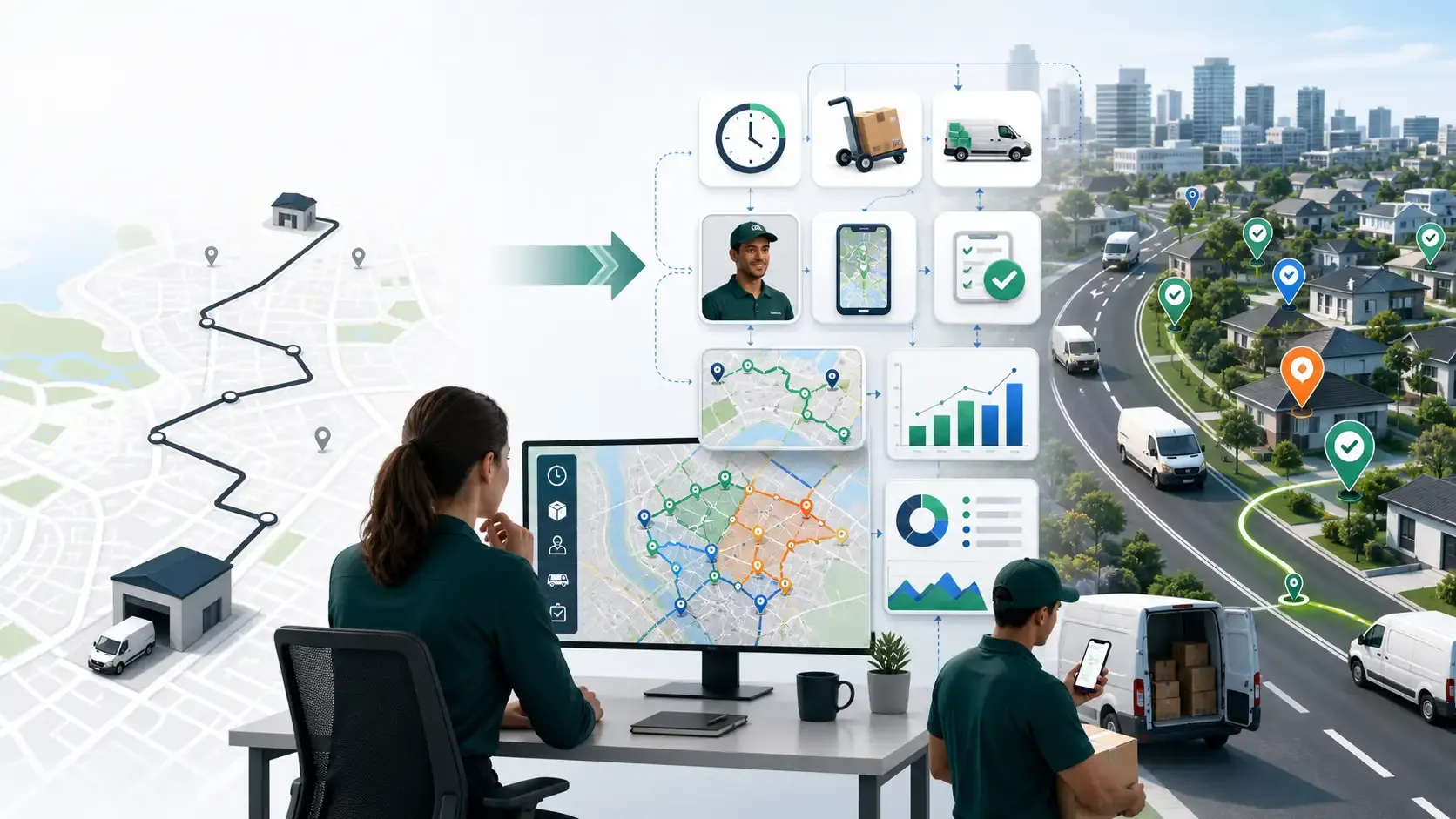
On this page
A shortest-path map can be useful.
It can show the fastest line between points, estimate travel distance, and help someone understand where stops are located.
But last-mile delivery is not just a map problem.
For Australian courier, ecommerce, grocery, field service, and last-mile delivery teams, the daily challenge is bigger than finding the shortest road between addresses. Dispatchers need to turn orders into realistic routes, assign the right drivers and vehicles, monitor active work, verify completion, and learn from delivery performance.
A shortest-path map does not understand all of that.
It may show where a driver could go. It does not necessarily show whether the route should be dispatched, whether the driver has the right context, whether the vehicle can carry the load, or whether the delivery was completed correctly.
That is why growing delivery teams eventually need more than a map. They need a connected route optimization workflow.
The Shortest Path Is Not Always the Best Delivery Route
The shortest route is not always the most practical route.
A delivery route may look efficient on a map but fail because it ignores operational constraints. A driver may reach the customer outside the time window. A van may be overloaded. A route may take longer than expected because service time was underestimated. A dispatcher may need to adjust stops before dispatch. A manager may need proof that a delivery was completed.
In other words, a route can be geographically efficient but operationally weak.
This is especially important in Australia, where delivery teams often manage a mix of dense metro suburbs, outer-suburban travel, industrial estates, regional distances, and branch-based operations.
A simple shortest-path map can help with navigation. But route optimization software should help teams plan around the real delivery day.
Last-Mile Delivery Has More Constraints Than Distance
Distance matters, but it is only one part of the planning problem.
A last-mile delivery route may need to consider:
- Customer time windows
- Stop duration
- Vehicle weight and volume capacity
- Driver availability
- Branch or depot context
- Pickup and delivery requirements
- Delivery priority
- Proof-of-delivery requirements
- Route assignment
- Live route progress
- Failed delivery reasons
A shortest-path map does not usually understand these constraints as part of one workflow.
For example, the map may show that Stop A is close to Stop B. But if Stop B can only receive deliveries in the morning, the route sequence may need to change. A basic map may show a fast route, but if the vehicle cannot carry the parcels, the plan fails before the driver leaves the depot.
Good last-mile delivery route planning connects the map with operational data.
Clean Delivery Data Comes Before Route Planning
A map can only work with the locations it receives.
If customer addresses are incomplete, coordinates are wrong, delivery dates are missing, or time windows are not recorded, the route plan becomes weaker. The problem may not appear on screen, but it will appear during dispatch.
This is why delivery teams need route-ready mission data before they optimize.
A mission should include the practical information that affects planning: customer details, address, coordinates, date, time window, service duration, parcel details, branch, priority, and delivery type.
Rouptimize’s delivery mission management software helps keep mission details connected to route planning, dispatch, driver work, and reporting.
When the mission data is clean, the map becomes more useful. When the data is weak, even the best-looking route can mislead the team.
Vehicle Capacity Changes the Route
A shortest-path map usually does not know whether a vehicle can carry the work.
But delivery teams care about vehicle capacity every day.
A route may include 40 stops, but the assigned van may only have room for 25 bulky parcels. A grocery route may need to consider vehicle suitability. A field service route may require specific tools. A courier route may need to balance weight, volume, and stop count.
For Australian delivery operators with mixed fleets, this is a practical issue. A small van, truck, ute, motorcycle, refrigerated vehicle, or branch-specific vehicle may all have different limits.
A better workflow considers vehicle capacity before dispatch.
Rouptimize’s guide to vehicle capacity route planning explains why weight, volume, and vehicle context should be part of the planning process, not something discovered at the loading dock.
Dispatchers Still Need Control
A shortest-path map may produce a route. But dispatchers still need to review the route before it goes to drivers.
Experienced dispatchers understand operational details that software may not fully capture. They may know that a customer location is difficult to access, a certain road becomes slow in the afternoon, a driver is better suited to one delivery zone, or a stop needs special attention.
That knowledge should not be lost.
A dispatcher map helps teams review route geometry, depots, assignments, route cards, mission details, and stop order before dispatch.
This matters because a strong delivery workflow is not “software replaces dispatchers.” It is “software gives dispatchers a better plan to review, adjust, and send.”
The dispatcher remains central to route quality.
Driver-Ready Routes Need More Than Directions
A shortest-path map may help with navigation, but drivers need more than directions.
Drivers need route context.
They need to know which route they are assigned, which stops are included, what details matter for each mission, how to update status, and how to complete delivery proof when required.
A driver who only receives a map route may still need to call dispatch for missing customer information, delivery instructions, or completion steps.
Rouptimize’s driver delivery app helps keep assigned routes and mission details connected to the driver workflow.
For last-mile delivery teams, this is important because every missing detail can create delay. A driver-ready route should be clear enough to execute, not just easy to view.
Live Monitoring Is Missing From Basic Maps
Once drivers leave the depot, the plan starts meeting reality.
Traffic changes. Customers are unavailable. Some stops take longer than expected. Routes fall behind. Drivers may need support. Dispatchers need to know which issues matter now.
A shortest-path map does not usually give dispatchers the full live delivery state.
Live delivery monitoring helps teams follow selected drivers, vehicles, current locations, last updates, mission status, and active work while routes are in progress.
This gives dispatchers visibility during the delivery day, not only after the route is finished.
The goal is not to micromanage drivers. The goal is to see exceptions early enough to respond.
Proof of Delivery Completes the Operational Record
A map can show that a driver reached an area. It does not prove the delivery was completed.
For delivery teams, completion matters. Managers may need to verify whether the customer received the order, whether proof was collected, and whether the mission status is reliable.
Rouptimize’s proof of delivery software helps teams connect delivery confirmation with the mission record.
This matters because proof should not be stored separately from the route. The strongest workflow connects the planned route, assigned driver, delivery status, proof record, and final report.
That gives operations teams a clearer view of what actually happened.
Reports Turn Delivery Activity Into Better Decisions
A shortest-path map helps plan one route. Reports help improve the next route.
Delivery teams need to know whether planned work matched completed work. They need to review route performance, driver activity, delays, failed deliveries, proof gaps, and repeated bottlenecks.
Rouptimize’s delivery reports and analytics help teams review completed work and route performance without rebuilding everything in spreadsheets.
This is where route optimization becomes more than a daily planning tool. It becomes part of a learning loop:
- Prepare delivery data
- Optimize routes
- Review and dispatch
- Monitor active work
- Verify completion
- Review reports
- Improve the next plan
A shortest-path map cannot manage that loop by itself.
Where Basic Maps Still Help
Basic maps are not useless. They are useful for navigation, location checking, quick visual review, and understanding geography.
The issue is expecting a map to manage the entire last-mile delivery operation.
A map can answer, “Where is this stop?”
A route optimization workflow answers much more:
- Which stops should be grouped together?
- Which driver should receive the work?
- Which vehicle can handle the route?
- Which time windows must be respected?
- Which route needs dispatcher review?
- Which driver is falling behind?
- Which deliveries were completed?
- Which report should change tomorrow’s plan?
For a growing delivery team, those questions matter more than the shortest line on a screen.
What Australian Teams Should Look For Instead
Australian delivery teams should look for software that supports the full route lifecycle.
The platform should help teams move from orders to route-ready missions, from missions to optimized routes, from optimized routes to assigned drivers, and from completed routes to performance reports.
Important capabilities include:
- Mission import and management
- Route optimization around real constraints
- Vehicle capacity and driver assignment
- Dispatcher map review
- Driver mobile app support
- Live delivery monitoring
- Proof of delivery
- Reports and analytics
- Branch and depot context
- Clear pricing that matches delivery volume
For a broader evaluation guide, read Route Optimization Software in Australia: What Delivery Teams Should Look For.
Why This Matters for Last-Mile Delivery
Last-mile delivery is where planning becomes visible to the customer.
If the route is unrealistic, the driver feels it. If the delivery is late, the customer feels it. If proof is missing, support teams feel it. If reports are unclear, managers repeat the same mistakes next week.
That is why last-mile teams need more than a shortest-path map.
They need a workflow that connects planning, dispatch, driver execution, monitoring, proof, and reporting.
Rouptimize supports that connected workflow across mission management, route optimization, dispatcher maps, driver apps, live monitoring, proof of delivery, and reports.
Conclusion: A Map Shows the Route, But Operations Need the Workflow
A shortest-path map can show a route. It cannot manage the full delivery operation.
Last-mile delivery teams need route planning that understands real constraints, supports dispatcher review, gives drivers useful context, monitors active progress, verifies completion, and helps managers improve the next dispatch cycle.
For Australian delivery teams working across metro, suburban, and regional delivery conditions, this difference matters.
Better route optimization is not only about finding the shortest path. It is about building routes that can be assigned, completed, verified, and improved.
Start free with Rouptimize
Written by
Results-oriented and visionary CEO with a passion for innovation and a track record of transforming startups into industry leaders. Seeking a leadership role in a dynamic startup environment where I can leverage my strategic acumen, entrepreneurial spirit, and hands-on experience to drive growth, build high-performing teams, and deliver unparalleled value to customers. Committed to fostering a culture of creativity, adaptability, and sustainable success.
Operations • Management • Route Optimization • Product Management • Logistics • Problem Solving
FAQ
Is the shortest path always the best delivery route?
No. The shortest path may ignore time windows, vehicle capacity, stop duration, driver assignment, proof of delivery, and live route progress. A practical delivery route needs to consider operational constraints, not just distance.
Why do last-mile delivery teams need route optimization software?
Last-mile delivery teams need route optimization software to plan routes around real delivery constraints, assign drivers, monitor active routes, verify completion, and improve future dispatch cycles.
What is the difference between a map and route optimization software?
A map mainly shows geography and navigation. Route optimization software helps teams plan, review, assign, monitor, complete, and report on delivery routes.
Why does vehicle capacity matter in route planning?
Vehicle capacity matters because a route can fail if the assigned vehicle cannot carry the parcels. Weight, volume, and vehicle suitability should be considered before dispatch.
How does live monitoring improve last-mile delivery?
Live monitoring helps dispatchers see route progress, driver location, mission status, and active exceptions while routes are in progress.
Why is proof of delivery important?
Proof of delivery helps teams verify completion, reduce disputes, and connect final delivery status to the mission record.
What should Australian delivery teams look for in route optimization software?
Australian teams should look for mission import, route optimization, dispatcher review, driver assignment, driver app support, live monitoring, proof of delivery, reports, and branch or depot context.