Grocery and Food Delivery Route Planning: Managing Time-Sensitive Orders in Australia
Grocery and food delivery routes need more than short distances. Teams must plan around customer time windows, freshness, vehicle suitability, driver context, live monitoring, and proof of delivery.
 Mohammad AlavitabarCEO @ Rouptimize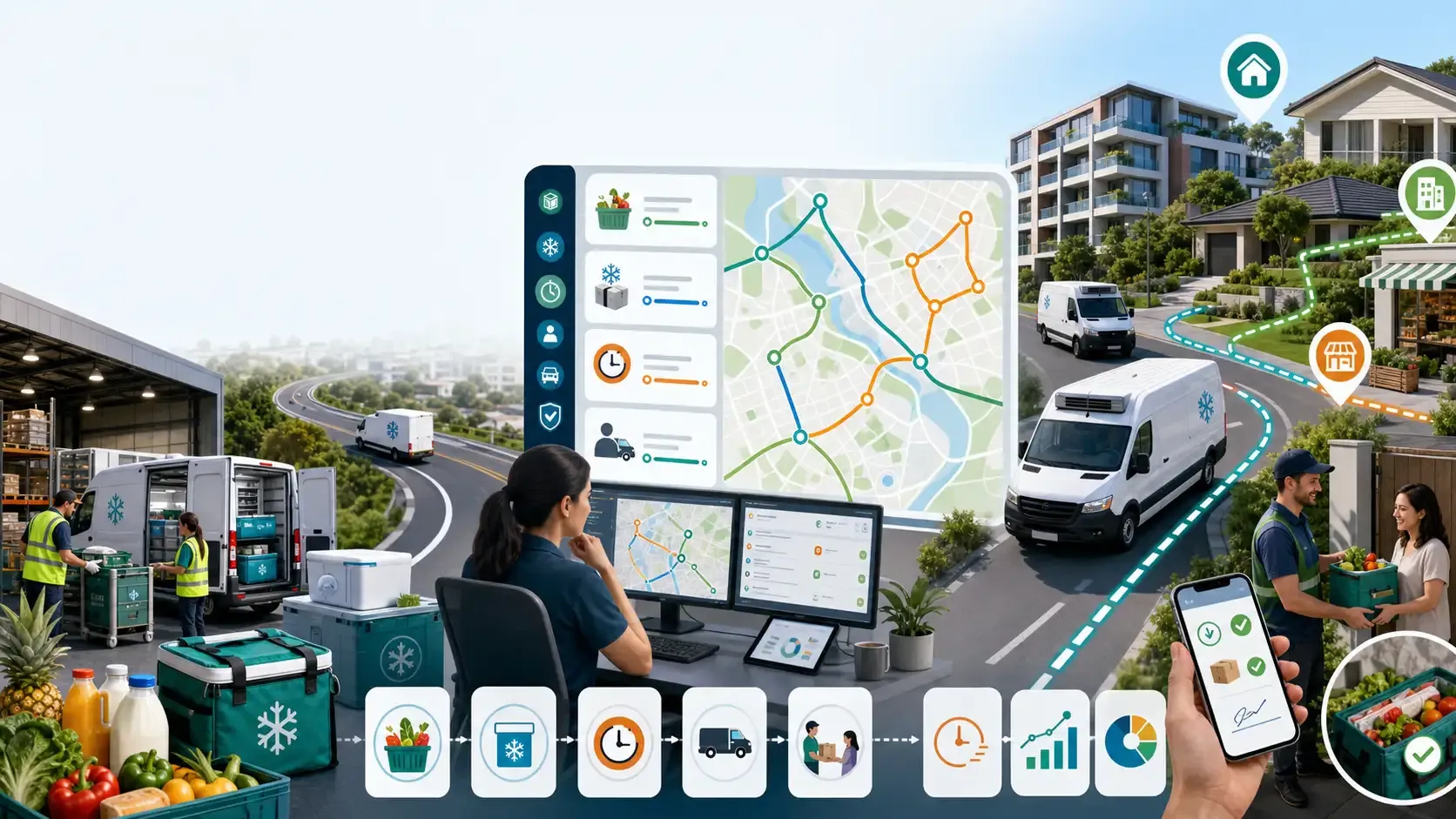
On this page
Grocery and food delivery routes have less room for delay.
A normal parcel may be late and still arrive in usable condition. A grocery order, fresh meal, chilled product, or temperature-sensitive delivery is different. Customers expect freshness, timing, and clear delivery completion.
For Australian grocery stores, food delivery operators, meal kit teams, fresh produce suppliers, pharmacy-adjacent retailers, and last-mile delivery businesses, route planning must handle more than distance.
The route needs to respect customer availability, freshness requirements, vehicle suitability, driver assignment, proof of delivery, and live dispatch visibility.
That is why grocery and food delivery route planning needs a connected workflow from order data to completed delivery.
Why Grocery and Food Routes Are Different
Grocery and food delivery is time-sensitive by nature.
A delivery team may be managing fresh items, chilled goods, frozen products, prepared meals, or customer-selected delivery windows. If the route is poorly planned, the impact is not only late delivery. It may affect product quality, customer trust, refund requests, and support workload.
For Australian operators, the challenge can vary by location. Dense metro routes may involve apartments, traffic, parking, and tight customer slots. Outer-suburban routes may involve longer travel times. Regional routes may have fewer backup options if something goes wrong.
A basic map can help drivers navigate, but grocery and food delivery teams need more than a shortest path.
They need practical grocery and food delivery route planning that understands the delivery workflow.
Start With Clean Order and Mission Data
Good grocery routing starts with clean delivery data.
Each order should become a route-ready mission with the details dispatchers need to plan the day. If order data is incomplete, drivers may face problems at the doorstep that could have been prevented earlier.
Useful mission details include:
- Customer name
- Delivery address
- Apartment or access instructions
- Delivery date
- Time window
- Order type
- Parcel or crate count
- Weight or volume where relevant
- Chilled or special handling notes
- Branch, store, depot, or fulfilment location
- Priority or urgency
Rouptimize’s delivery mission management software helps keep mission details connected to route planning, dispatch, driver work, proof, and reports.
For grocery and food delivery, this matters because freshness and timing depend on the quality of the mission record.
Time Windows Are Central to Grocery Delivery
Customer availability is one of the biggest constraints in grocery and food delivery.
Many customers choose delivery windows because they want to receive perishable goods directly. A missed window can create redelivery cost, spoiled goods, customer complaints, or refund pressure.
Delivery teams should treat time windows as real planning data, not loose notes.
A strong route planning workflow should help dispatchers consider:
- Customer-selected delivery slots
- Store or branch dispatch time
- Driver availability
- Route duration
- Stop duration
- Delivery priority
- Live route progress
- Missed-window risk
Rouptimize’s article on delivery time windows explains why routes should be built around customer availability, not just distance.
Vehicle Suitability Matters for Fresh and Chilled Goods
Vehicle choice can affect delivery quality.
Some grocery and food deliveries may need refrigerated vehicles, insulated bags, chilled storage, or faster route cycles. Even when refrigeration is not required, the route should still consider vehicle capacity and order handling.
A route can fail if the assigned vehicle cannot carry the order volume or cannot support the delivery type.
Dispatchers should consider:
- Vehicle capacity
- Temperature or handling requirements
- Order volume
- Route duration
- Loading sequence
- Driver and vehicle availability
- Branch or depot assignment
Rouptimize’s fleet management features help teams manage vehicles, drivers, capacity, skills, and assignments as part of the planning workflow.
For deeper capacity planning, read [Vehicle Capacity Planning: How to Prevent Overloaded Routes Before Dispatch](https://rouptimize.com/en/blog/vehicle-capacity-planning-overloaded-routes).
Route Optimization Should Respect Freshness and Timing
The best grocery delivery route is not always the shortest route.
A route may need to prioritize time-sensitive orders, customer windows, depot start time, vehicle suitability, and realistic stop duration.
Good route optimization software helps teams plan routes around real delivery constraints. For grocery and food delivery, this can support better order grouping, driver workload, vehicle assignment, and customer service.
Important route planning questions include:
- Which orders need earlier delivery?
- Which customers have narrow windows?
- Which route can the driver complete on time?
- Which vehicle is suitable for the load?
- Which branch or depot should serve the customer?
- Which route needs dispatcher review before dispatch?
The goal is not only lower distance. The goal is a route that protects delivery quality.
Dispatchers Need Review Before Drivers Leave
Grocery and food delivery operations often require human judgement.
A dispatcher may know that a building has difficult access, a suburb becomes slow at school pickup time, a customer frequently misses calls, or a route is too tight for fresh delivery.
A dispatcher map helps dispatchers review route geometry, mission details, depots, assignments, and stop order before dispatch.
This review step is important because route optimization should support dispatcher decisions, not remove them.
For time-sensitive delivery, dispatchers need a chance to identify risk before drivers leave the store, depot, or fulfilment centre.
Drivers Need Clear Mobile Context
Drivers carrying grocery and food orders need clear route information.
They need to know which route they are assigned, what stop comes next, which deliveries are time-sensitive, what customer instructions matter, and how to update delivery status.
A driver delivery app helps keep assigned routes and mission details connected to the driver workflow.
This is especially useful for grocery and food routes because the driver may need to manage customer handover, access instructions, proof of delivery, and delivery timing in one field workflow.
You can also read more about driver delivery apps after routes are assigned.
Live Monitoring Helps Protect Time-Sensitive Routes
Once drivers leave, dispatch teams need visibility.
Time-sensitive delivery routes can fall behind because of traffic, parking, access problems, customer delays, or longer-than-expected stop duration. If dispatchers only find out after the route is finished, it is too late to act.
Rouptimize’s live delivery monitoring helps teams follow selected drivers, vehicles, live locations, last updates, mission status, and active delivery progress.
This helps dispatchers focus on routes that need attention.
For Australian grocery and food delivery teams, live monitoring can help reduce missed windows and protect customer experience during the delivery day.
Proof of Delivery Reduces Disputes
Proof of delivery is important when customers are receiving fresh or time-sensitive goods.
A customer may later say the order was not received, was delivered late, or was left incorrectly. Operations teams need a clear record tied to the mission.
Rouptimize’s proof of delivery software supports code-based confirmation so completion can stay connected to the delivery record.
This keeps the workflow lightweight for drivers and customers while giving managers better visibility into completed deliveries.
For more detail, see proof-of-delivery confirmation codes.
Reports Help Improve Future Grocery Routes
Grocery and food delivery teams should review route performance after the delivery day.
Reports help managers understand what worked, what failed, and what should change before the next dispatch cycle.
Useful reporting questions include:
- Which orders missed delivery windows?
- Which routes ran late?
- Which areas caused repeated delays?
- Which drivers had overloaded routes?
- Which branches had the most exceptions?
- Which customers had repeated failed attempts?
- Which vehicle or route assumptions need adjustment?
Rouptimize’s delivery reports and analytics help teams compare planned work, completed work, driver activity, route performance, and operational bottlenecks.
This turns daily delivery outcomes into better planning data for the future.
Common Grocery and Food Delivery Planning Mistakes
Many teams repeat the same mistakes.
They plan routes only by geography. They underestimate stop duration. They ignore customer time windows. They assign vehicles without checking suitability. They send drivers with incomplete instructions. They monitor routes too late. They collect proof outside the mission record. They review delivery issues only after customer complaints.
These mistakes create avoidable failures.
A better workflow connects order data, route optimization, dispatcher review, driver assignment, mobile context, live monitoring, proof, and reporting.
Why This Matters in Australia
Australian grocery and food delivery teams operate across varied conditions.
A metro delivery route may face congestion, apartment access, customer parking constraints, and tight delivery slots. An outer-suburban route may involve longer drive times and fewer opportunities to recover from delays. Regional routes may need even stronger planning discipline because route errors are harder to fix once drivers leave.
Customers expect freshness and reliability.
This is why route optimization software in Australia should be evaluated beyond shortest distance. For grocery and food delivery, the workflow must support timing, vehicle context, driver execution, live visibility, proof, and reporting.
Conclusion: Time-Sensitive Routes Need Connected Planning
Grocery and food delivery route planning is about more than getting from one address to another.
Teams need to manage freshness, time windows, vehicle suitability, driver context, dispatch review, live progress, proof of delivery, and reporting.
Australian delivery teams can reduce missed windows and improve delivery reliability by connecting the full workflow from order import to completed mission.
Rouptimize helps grocery and food delivery teams plan, dispatch, monitor, verify, and review delivery work across mission management, route optimization, dispatcher maps, driver apps, live monitoring, proof of delivery, fleet management, and reports.
Written by
Results-oriented and visionary CEO with a passion for innovation and a track record of transforming startups into industry leaders. Seeking a leadership role in a dynamic startup environment where I can leverage my strategic acumen, entrepreneurial spirit, and hands-on experience to drive growth, build high-performing teams, and deliver unparalleled value to customers. Committed to fostering a culture of creativity, adaptability, and sustainable success.
Operations • Management • Route Optimization • Product Management • Logistics • Problem Solving
FAQ
What is grocery delivery route planning?
Grocery delivery route planning is the process of turning grocery or food orders into routes that consider customer time windows, freshness, vehicle suitability, driver assignment, dispatch visibility, and proof of delivery.
Why are grocery and food deliveries time-sensitive?
Grocery and food deliveries are time-sensitive because customers expect fresh products, chilled items, prepared meals, or scheduled delivery windows to arrive within a practical timeframe.
How does route optimization help grocery delivery teams?
Route optimization helps teams plan routes around customer locations, time windows, depot context, vehicle suitability, driver availability, and delivery workload.
Why do drivers need mobile context for grocery delivery?
Drivers need mobile context so they can see assigned routes, mission details, customer instructions, delivery status workflow, and proof-of-delivery steps.
How does live monitoring support food delivery routes?
Live monitoring helps dispatchers see route progress, driver context, mission status, and active exceptions while time-sensitive deliveries are still in progress.
Why is proof of delivery useful for grocery orders?
Proof of delivery helps teams confirm that the order was completed and gives managers a clearer record if a customer dispute appears later.
What should Australian grocery delivery teams look for in route planning software?
Australian grocery delivery teams should look for route optimization, time-window planning, vehicle suitability, driver app support, live monitoring, proof of delivery, reporting, and branch or depot context.