Delivery Time Windows: How to Build Routes Customers Can Actually Receive
Delivery time windows help teams plan routes around real customer availability, not just distance. Better time-window data leads to more realistic routes, fewer failed attempts, and stronger dispatch control.
 Mohammad AlavitabarCEO @ Rouptimize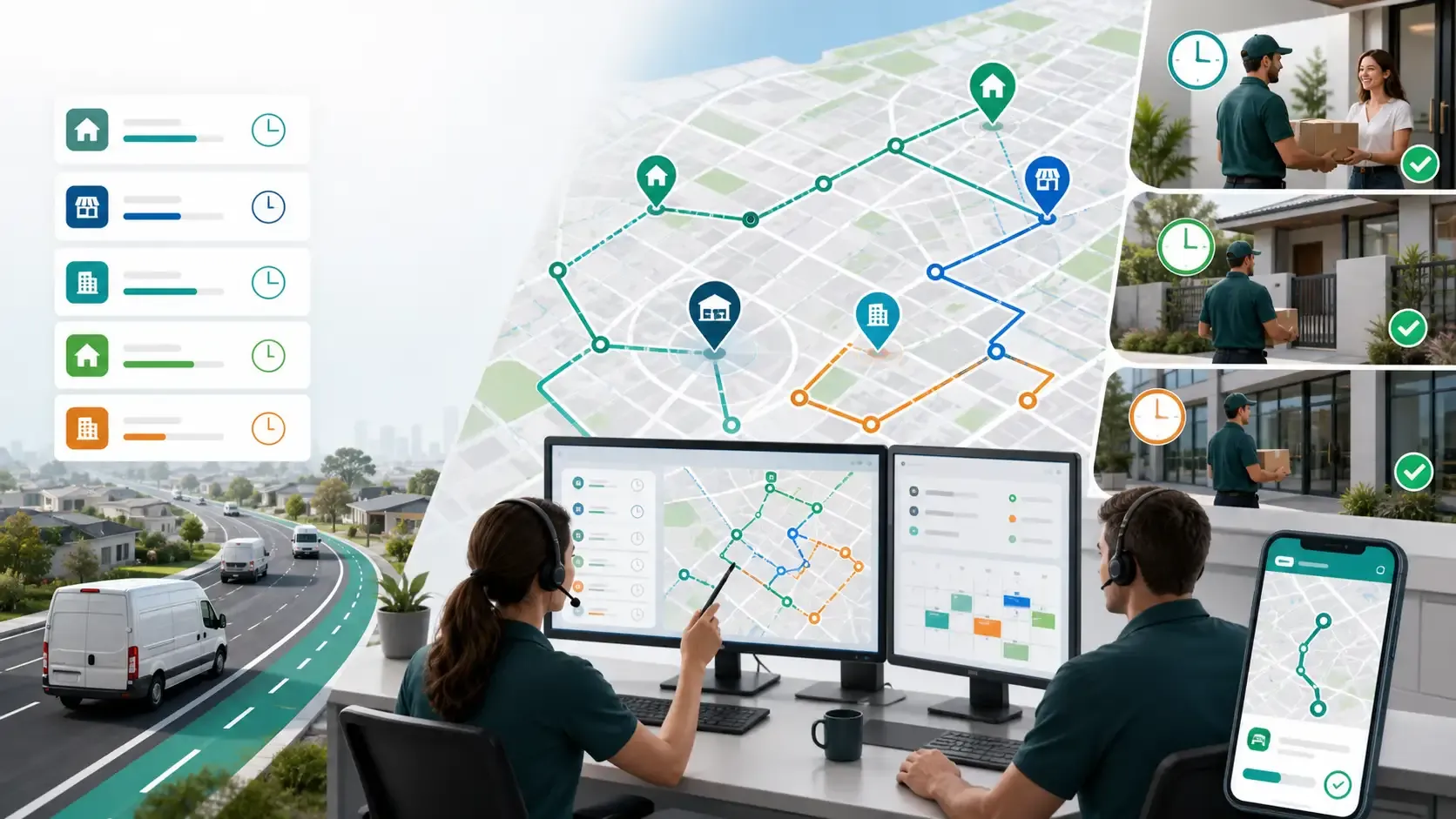
On this page
A delivery route can look efficient and still fail.
The stops may be close together. The distance may look reasonable. The driver may follow the planned sequence. But if customers are not available when the driver arrives, the route does not work.
That is why delivery time windows matter.
For Australian courier, ecommerce, grocery, field service, and last-mile delivery teams, the goal is not only to build shorter routes. The goal is to build routes customers can actually receive.
A delivery time window gives the route plan a customer availability constraint. It helps dispatchers understand when each stop can be completed, not just where each stop is located.
What Is a Delivery Time Window?
A delivery time window is the period when a customer can receive a delivery.
For example, a business customer may only accept deliveries during receiving hours. A residential customer may prefer an afternoon delivery. A grocery customer may choose a narrow arrival slot. A field service job may need to happen before a site closes.
In route planning, time windows help decide the stop sequence.
A stop that is farther away may need to happen earlier because the customer has a limited window. A nearby stop may need to wait because the customer is not available yet.
This is why time-window planning is more complex than simple distance-based routing.
A route optimization software workflow should help delivery teams plan around customer availability, vehicles, drivers, depots, and route workload together.
Why Short Routes Can Still Miss Customers
Many delivery teams start with a simple goal: reduce distance.
That goal makes sense. Less distance can reduce drive time, fuel use, and operating cost. But distance is not the only factor that determines route success.
A route can be short and still miss customer availability.
This often happens when planning ignores:
- Customer receiving hours
- Preferred delivery slots
- Hard appointment times
- Driver shift limits
- Stop duration
- Depot start times
- Branch context
- Traffic patterns
- Proof-of-delivery requirements
For Australian delivery teams, this matters because customer expectations vary by industry. A grocery customer may expect a narrow slot. A business delivery may need to arrive during warehouse hours. A field service customer may only be available at a certain time.
A route that ignores these windows may be efficient for the vehicle but inconvenient for the customer.
Hard Time Windows vs Preferred Time Windows
Not every time window has the same importance.
A hard time window is a requirement. The delivery must happen inside that window or the attempt may fail. This is common for B2B receiving hours, scheduled service appointments, customer-selected slots, regulated goods, or deliveries that require someone to be present.
A preferred time window is more flexible. The customer would like the delivery during that period, but the business may still complete the delivery outside the preferred time if needed.
Delivery teams should separate these two types of time windows.
If every window is treated as hard, route planning may become too restrictive. If every window is treated as flexible, the route may create missed commitments.
Better time-window data helps dispatchers understand what must happen and what should happen.
Time Windows Need Clean Mission Data
Time windows are only useful when they are stored clearly in the delivery mission.
A mission record should include the delivery date, customer location, time window, service duration, delivery type, branch, priority, and any important instructions.
If time-window details live in a separate spreadsheet, customer note, email, or manual dispatch message, they are easy to miss.
Rouptimize’s delivery mission management software helps keep delivery details connected to route planning, dispatch, driver work, and reports.
Clean mission data allows the route plan to reflect real customer commitments.
Importing Time Windows From Order Data
Many delivery teams receive time-window information from ecommerce exports, customer service systems, warehouse tools, or spreadsheets.
The challenge is keeping that data structured when it enters the route planning workflow.
A good import process should preserve fields such as:
- Delivery date
- Earliest delivery time
- Latest delivery time
- Customer preference
- Service duration
- Priority
- Branch or depot
- Delivery instructions
Rouptimize supports teams that need to import delivery missions from CSV, XLSX, or JSON, helping delivery teams bring route-relevant data into the planning process.
This matters because time-window problems often begin before dispatch. If the time data is missing or unclear, the route plan starts with a weak assumption.
Service Time Affects Every Window
A delivery time window is not only about arrival.
The driver also needs enough time to complete the stop.
Service time may include parking, walking to the delivery point, finding the recipient, unloading parcels, collecting proof of delivery, and returning to the vehicle.
If service time is underestimated, the route can miss later time windows even when the first stops are completed successfully.
For example, a route may include several apartment deliveries, business receptions, or warehouse handovers. Each stop may take longer than expected. By the middle of the route, the driver is already behind.
That is why time-window planning should consider both travel time and stop duration.
Rouptimize’s guide to delivery performance metrics can help teams think about planning assumptions versus real delivery outcomes.
Vehicle and Driver Context Still Matter
Time windows do not exist in isolation.
A route also depends on vehicle capacity, driver availability, branch context, and depot location. A driver may not be able to meet a delivery window if the route starts from the wrong depot, the vehicle is overloaded, or too many stops are assigned before the time-sensitive delivery.
This is why route planning needs connected operational data.
A time-window-aware route should consider:
- Vehicle capacity
- Driver shift times
- Depot start and end points
- Branch ownership
- Stop duration
- Travel time
- Mission priority
- Proof-of-delivery needs
Rouptimize’s fleet management features help teams manage vehicles, drivers, assignments, capacity, and operating context in the route planning workflow.
Dispatchers Need to Review Time-Window Risk
Even with good route optimization, dispatchers should review time-window risk before sending routes to drivers.
A route may technically fit the constraints but still feel tight. The dispatcher may know a certain customer is slow to receive deliveries, a site has access problems, or a route becomes unreliable during a certain part of the day.
A dispatcher map helps teams review route geometry, mission details, depots, assignments, and stop order before dispatch.
This review step matters because time-window success depends on both data and judgement.
A strong workflow gives dispatchers the ability to inspect routes, adjust where needed, and send drivers work that is more realistic.
Drivers Need Time-Window Context in the Mobile App
Time windows should not stay only on the dispatcher’s screen.
Drivers need to know which stops are time-sensitive, what details matter, and how their route should be completed.
If drivers do not see time-window context, they may follow the route sequence without understanding which stops carry more urgency.
A driver delivery app helps keep assigned route work and mission details available in the field.
This is important for Australian delivery teams managing busy metro routes, apartment deliveries, business receiving hours, grocery slots, or customer-selected delivery windows.
Better driver context helps the route plan survive real-world execution.
Live Monitoring Helps Protect Time Windows
Even a well-planned route can fall behind.
Traffic, customer delays, parking issues, access problems, and longer-than-expected service times can push the route out of schedule.
This is where live delivery monitoring becomes valuable.
Live monitoring helps dispatchers see active route progress, driver context, mission status, and updates during the delivery day. If a time-sensitive stop is at risk, the team may still have time to respond.
For example, dispatchers may contact the customer, adjust expectations, support the driver, or review whether another route needs intervention.
The goal is not to watch every movement. The goal is to make timing problems visible early enough to act.
Proof of Delivery Confirms the Outcome
Time-window planning is about getting the customer the delivery at the right time. Proof of delivery confirms whether the delivery was completed.
Rouptimize’s proof of delivery software helps teams connect completion status with the mission record.
This matters because delivery teams need to know not only whether the driver arrived, but whether the delivery was actually completed and verified.
If a time-window delivery is disputed later, a connected proof record gives the team a clearer operational history.
Reports Help Improve Future Time Windows
Time windows should improve over time.
A delivery team should be able to review which time windows were realistic, which routes ran late, which customers created repeated delays, and which planning assumptions need adjustment.
Rouptimize’s delivery reports and analytics help teams compare planned work, completed work, route performance, driver activity, and operational bottlenecks.
Useful reporting questions include:
- Which deliveries missed time windows?
- Which routes were too tight?
- Which customers often cause delays?
- Which branches have repeated timing issues?
- Which stop durations were underestimated?
- Which routes need fewer stops next time?
This reporting loop helps teams build better time-window rules for future dispatch cycles.
Why Time Windows Matter in Australia
Australian delivery teams often manage a difficult mix of delivery conditions.
Dense metro areas can create traffic and parking challenges. Outer-suburban routes may involve longer distances between stops. Regional deliveries may have fewer recovery options if the route falls behind. Business customers may have strict receiving hours. Residential customers may expect clearer delivery timing.
Because of this, customer availability matters.
A route that ignores time windows may produce more failed attempts, more support calls, and more redelivery cost.
For teams evaluating route optimization software in Australia, time-window planning should be part of the decision.
Common Time-Window Planning Mistakes
Many teams make the same mistakes with time windows.
They use default windows for every customer. They treat preferred times as hard commitments. They ignore service time. They keep customer availability in notes instead of structured fields. They do not show time-window context to drivers. They review missed windows only after customers complain.
These mistakes make routes less reliable.
A better approach is to treat time windows as operational data that should flow through the full delivery workflow: mission import, route optimization, dispatcher review, driver app, live monitoring, proof of delivery, and reports.
Conclusion: Build Routes Around Customer Availability
Delivery time windows help teams plan routes customers can actually receive.
A route should not only be short. It should respect customer availability, vehicle and driver constraints, depot context, service time, and field execution.
Australian delivery teams can reduce missed windows and failed delivery attempts by capturing better time-window data, planning around real constraints, reviewing routes before dispatch, giving drivers clear context, monitoring active progress, and learning from reports.
Rouptimize helps teams connect mission management, route optimization, dispatcher maps, driver workflows, live monitoring, proof of delivery, and reporting so time windows become part of the delivery workflow, not a manual afterthought.
Written by
Results-oriented and visionary CEO with a passion for innovation and a track record of transforming startups into industry leaders. Seeking a leadership role in a dynamic startup environment where I can leverage my strategic acumen, entrepreneurial spirit, and hands-on experience to drive growth, build high-performing teams, and deliver unparalleled value to customers. Committed to fostering a culture of creativity, adaptability, and sustainable success.
Operations • Management • Route Optimization • Product Management • Logistics • Problem Solving
FAQ
What are delivery time windows?
Delivery time windows are the periods when customers can receive deliveries. They help route planners schedule stops around real customer availability.
Why do time windows matter in route planning?
Time windows matter because the shortest route may still fail if drivers arrive when customers are unavailable. Time-window planning helps teams build routes that can actually be completed.
What is the difference between hard and preferred time windows?
A hard time window is a requirement. A preferred time window is more flexible. Separating the two helps teams balance customer commitments with route efficiency.
How can Australian delivery teams reduce missed delivery windows?
Teams can reduce missed windows by collecting accurate customer availability, planning around real constraints, giving drivers time-window context, monitoring active routes, and reviewing reports after dispatch.
How does route optimization software use time windows?
Route optimization software can use time windows as constraints when sequencing stops and assigning route work to vehicles and drivers.
Why should drivers see time-window context?
Drivers need time-window context so they understand which stops are time-sensitive and can follow the route with the right operational priorities.
How do reports improve time-window planning?
Reports help managers identify missed windows, unrealistic routes, repeated customer delays, and stop-duration assumptions that need to change.