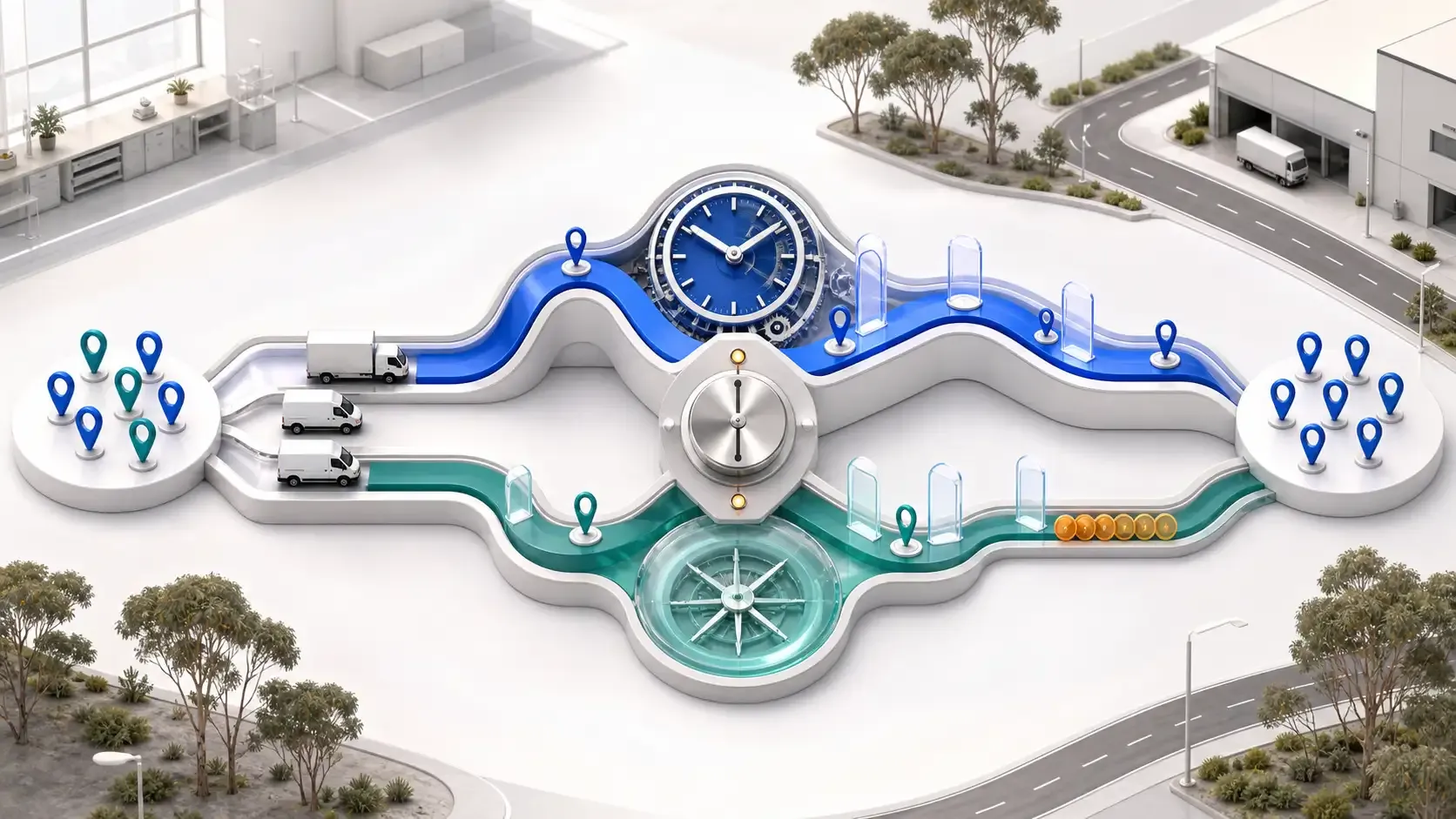
Time-Focused vs Distance-Focused Route Optimization: Which Objective Should You Choose?
The lowest-distance route plan may require more operating hours, while the lowest-time plan may travel farther. The right objective depends on labour, vehicle, distance and service costs.
Time vs Distance In Route Optimization | Rouptimize
A distance-focused plan may travel fewer kilometres while requiring more driver hours. A time-focused plan may cover additional distance while completing the work sooner.
Neither objective is automatically correct.
Australian delivery teams need to choose an optimization objective that reflects their actual cost structure, customer commitments and operating constraints.
What Is a Route Optimization Objective?
A route optimization objective tells the planning system what result to prefer after the essential delivery constraints have been considered.
Constraints can include:
Vehicle capacity
Driver and vehicle working hours
Customer time windows
Service duration
Depot locations
Required skills
Mission priority
Pickup and delivery relationships
Resource availability
The objective then helps compare feasible alternatives.
For example, two route plans may both respect capacity and customer windows. One has lower total distance. The other requires fewer operating hours.
The objective determines which trade-off receives more importance.
Route optimization software should help managers evaluate the complete fleet plan rather than drawing the shortest line between individual stops.
What Is Time-Focused Route Optimization?
A time-focused objective priorities reducing the planned time required to complete the selected delivery work.
Depending on the planning model, this may involve:
Reducing total route duration
Avoiding slow stop sequences
Balancing service-intensive missions
Using faster route combinations
Reducing waiting between customer windows
Keeping routes inside working hours
Completing urgent work earlier
Reducing total fleet operating time
Time-focused optimization does not mean encouraging drivers to travel faster or ignore safety requirements.
It means arranging the work so the planned combination of travel, waiting and service activity requires less operating time.
What Is Distance-Focused Route Optimization?
A distance-focused objective priorities reducing the total kilometres travelled by the selected fleet.
It may help the operation:
Reduce route overlap
Group nearby missions
Avoid unnecessary return travel
Limit duplicated service areas
Reduce long connections between stops
Reduce distance-related vehicle exposure
Distance-focused planning can be particularly valuable when per-kilometre costs are a major concern.
It still needs to respect vehicle capacity, working windows, customer commitments and other recorded constraints.
What Real Operational Data Shows
An anonymized one-day planning analysis used real operational data from four depots to compare a recorded baseline with time-focused and distance-focused alternatives.
Planning scenario
Vehicles
Total operating hours
Total distance
Recorded baseline
55
530 hours
3,619 km
Time-focused plan
51
521 hours
3,201 km
Distance-focused plan
51
554 hours
2,939 km
Both alternative plans used 51 vehicles.
Their time and distance results were very different.
Change from recorded baseline
Time-focused plan
Distance-focused plan
Vehicle count
7.3% lower
7.3% lower
Total operating hours
1.7% lower
4.5% higher
Total distance
11.6% lower
18.8% lower
Compared directly with the time-focused plan, the distance-focused alternative:
Travelled 262 fewer kilometres
Required 33 additional operating hours
Reduced distance by approximately 8.2%
Increased total hours by approximately 6.3%
Used the same number of vehicles
*Benchmark note: Percentages were calculated from the displayed totals and rounded. This is an anonymized historical planning analysis using real operational data. The scenarios are modelled alternatives, not Australian customer implementations or audited post-deployment savings.*
The table does not reveal one universally better plan. It reveals the decision that managers need to value.
Is saving 262 kilometres worth 33 additional operating hours?
The answer depends on the operation.
Translate the Trade-Off Into Cost
Managers can compare planning objectives using four cost layers.
Cost layer
Inputs to review
Distance cost
Kilometres and vehicle-specific cost per kilometre
Time cost
Driver and vehicle hours with applicable labour or contractor rates
Vehicle cost
Owned, leased, hired or contracted vehicles used
Exception cost
Failed deliveries, redelivery, missed windows and additional administration
A practical scenario estimate can be expressed as:
Service Duration Can Change the Preferred Objective
Travel time is only part of a route.
Suppose a delivery route contains 20 stops and each stop requires 15 minutes of service. The route contains five hours of service activity before travel, loading, waiting or return time is considered.
If service durations are missing, the planner may treat a dense group of nearby customers as a highly efficient route.
The kilometres may be low, but the working time may exceed the available day.
Accurate mission records should therefore include realistic service-duration values.
Time-focused optimization becomes difficult to evaluate when the plan only understands travel.
Working Windows Can Override Both Objectives
A low-distance route and a low-time route are both unusable if they exceed a valid resource window.
Vehicle and driver availability should be treated as planning constraints rather than optional preferences.
The optimizer should compare objectives within those genuine limits.
Capacity May Prevent the Preferred Plan
A distance-focused route may group nearby missions into one compact workload.
If the assigned vehicle cannot carry the combined item count, weight or volume, the plan must change.
A time-focused plan may select a larger vehicle that carries more work but creates a different distance or vehicle cost.
Capacity should therefore be included before objectives are compared.
A route is not genuinely time-efficient or distance-efficient if it cannot be loaded and dispatched.
Why Vehicle Count Stayed the Same in the Benchmark
Both alternative plans used 51 vehicles.
This is useful because it isolates the time-and-distance trade-off more clearly.
The distance-focused result did not save additional vehicles. It saved kilometres while increasing operating hours.
In another operation, the objectives could also change the number or type of vehicles selected.
Managers should always compare:
Vehicles used
Vehicle types
Total hours
Total distance
Capacity utilization
Unassigned missions
Expected delivery completion
One objective should not be evaluated through one metric.
A Balanced Objective May Be More Practical
Many delivery operations do not want the absolute minimum time or the absolute minimum distance.
They want a plan that controls both.
A balanced decision may give importance to:
Distance-related cost
Driver and vehicle time
Vehicle count
Capacity
Customer commitments
Route workload
Delivery priority
Operational resilience
The best balance can also change between planning periods.
A peak-volume day may priorities completion within available hours. A quieter regional day may place more weight on avoiding unnecessary kilometres.
A route objective should reflect the current operating problem, not remain an unquestioned default.
Australian Route Environments Need Different Priorities
A single Australian delivery operation may serve very different areas.
Dense metropolitan areas
Time can be heavily influenced by traffic, parking, customer access, waiting and service duration.
Outer-suburban areas
Time and distance may both matter, with moderate stop density and longer connections between customer groups.
Regional areas
Distance may dominate the route, while stop count and service density remain lower.
Mixed depot networks
Mission allocation between branches can influence both route time and distance before stop sequencing begins.
Managers should segment results by route environment rather than applying one objective across every part of the fleet without review.
Customer Experience Can Change the Decision
The lowest-cost plan is not useful if it repeatedly breaks customer commitments.
Time-focused planning may help when customers depend on narrow delivery windows or urgent completion.
Distance-focused planning may remain suitable where service windows are broad and additional time does not affect the customer promise.
Useful customer measures include:
On-time completion
Failed delivery rate
Redelivery rate
Delivery-related support contacts
Missed time windows
Completion confirmation
Customer complaints
These outcomes should be valued as part of exception cost.
Neither historical benchmark directly measures customer satisfaction, sales or marketing savings. Those effects require separate customer and commercial evidence.
Dispatcher Review Protects Both Objectives
An optimization objective provides a preferred plan. Dispatchers still need to review whether the result reflects operational reality.
Using the dispatcher map, teams can examine route geometry, duration, distance, ETAs, stop order and assignments before dispatch.
A useful review asks:
What did this objective improve?
What became worse?
Are the vehicle and driver assignments practical?
Does every route fit capacity and working windows?
Are customer time windows achievable?
Is workload balanced?
Is any mission unassigned?
Does the financial trade-off support the selected objective?
The route should be approved because the trade-off is understood, not because one metric is the lowest.
How to Test Route Objectives With Your Own Data
Australian delivery teams can run a controlled comparison:
Select a representative delivery period.
Use the same missions, vehicles, depots and constraints for every scenario.
Generate a time-focused plan.
Generate a distance-focused plan.
Keep data definitions consistent.
Compare vehicles, hours, kilometres and unassigned work.
Apply vehicle-specific distance costs.
Apply relevant labour and contractor costs.
Review customer-window and completion risk.
Have dispatchers assess route practicality.
Test the preferred plan operationally.
Compare planned and completed results.
Repeat across several route environments.
Changing several inputs between scenarios makes the objective comparison unreliable.
Metrics to Compare
A route-objective scorecard can include:
Total distance
Total operating hours
Vehicles used
Kilometres per completed mission
Driver hours per completed mission
Missions per vehicle
Capacity utilization
Unassigned missions
Planned versus actual route duration
Failed and rescheduled deliveries
Contractor use
Cost per completed delivery
The guide to cost-per-delivery metrics explains how these measures contribute to the complete financial result.
Rouptimize’s reports and analytics keep route, mission, driver and fleet results connected to the planning workflow.
Avoid Common Objective-Selection Mistakes
Choosing minimum distance by default
Distance may be easy to understand, but it may not represent the largest cost.
Calling time-focused routes “faster driving”
The objective concerns planned operating time, not vehicle speed or unsafe behaviour.
Ignoring service time
A route cannot be evaluated properly using travel time alone.
Comparing scenarios with different inputs
The missions, vehicles and constraints should remain consistent.
Treating modeled results as realized savings
A model identifies an opportunity. Operational execution determines the result.
Ignoring unassigned missions
A scenario can look efficient because difficult work was left outside the plan.
Applying one objective to every route type
Metropolitan and regional operations can have different cost drivers.
Use Reports to Refine the Objective
The first selected objective may not remain the best one.
After dispatch, managers should compare planned and completed:
Distance
Route duration
Mission completion
Working hours
Vehicle use
Capacity
Delivery exceptions
If a distance-focused plan regularly creates additional hours, its weighting may need adjustment.
If a time-focused plan creates excessive kilometres without improving completion, the operation may need to investigate route settings, mission data or the objective itself.
The strongest objective is developed through repeated planning, measurement and revision.
Choose the Trade-Off You Can Defend
Time and distance are both valuable route measures.
The right objective is the one that reflects the cost and service problem the delivery operation is trying to solve.
Use the same missions, fleet and constraints to compare scenarios. Value the difference using real labour, vehicle and distance costs. Then review whether the route can be executed as planned.
Start free with Rouptimize and compare time-focused and distance-focused route plans using your own operational data.
Results-oriented and visionary CEO with a passion for innovation and a track record of transforming startups into industry leaders. Seeking a leadership role in a dynamic startup environment where I can leverage my strategic acumen, entrepreneurial spirit, and hands-on experience to drive growth, build high-performing teams, and deliver unparalleled value to customers. Committed to fostering a culture of creativity, adaptability, and sustainable success.
What is the difference between time-focused and distance-focused route optimization?
Time-focused planning priorities reducing total planned operating time. Distance-focused planning priorities reducing total kilometres. Both still need to respect the supplied constraints.
Is the shortest route always the fastest route?
No. A shorter route can contain slower roads, more stops, waiting or longer service activity.
Which objective reduces delivery cost more?
It depends on the operation’s labour, vehicle, fuel, maintenance and exception costs. Managers should value the complete scenario using their own data.
Can a distance-focused route use more driver hours?
Yes. The anonymized four-depot benchmark showed a lower-distance plan that required 33 more operating hours than the time-focused alternative.
Does time-focused optimization encourage speeding?
No. It organizes routes and workloads to reduce planned time. Drivers must continue to operate safely and within applicable requirements.
Should Australian delivery teams use one objective for every route?
Not necessarily. Metropolitan, outer-suburban and regional operations can have different cost and service priorities.
Can the route objective change the number of vehicles?
Yes. Depending on capacity, working hours, customer windows and demand, different objectives may produce different fleet requirements.
 Mohammad AlavitabarCEO @ Rouptimize