Why a Shorter Route Can Still Be the Wrong Route for Your Fleet
The route with the fewest kilometres is not always the most practical or economical plan. Fleet capacity, operating hours, service time and customer commitments can make a slightly longer route the better decision.
 Mohammad AlavitabarCEO @ Rouptimize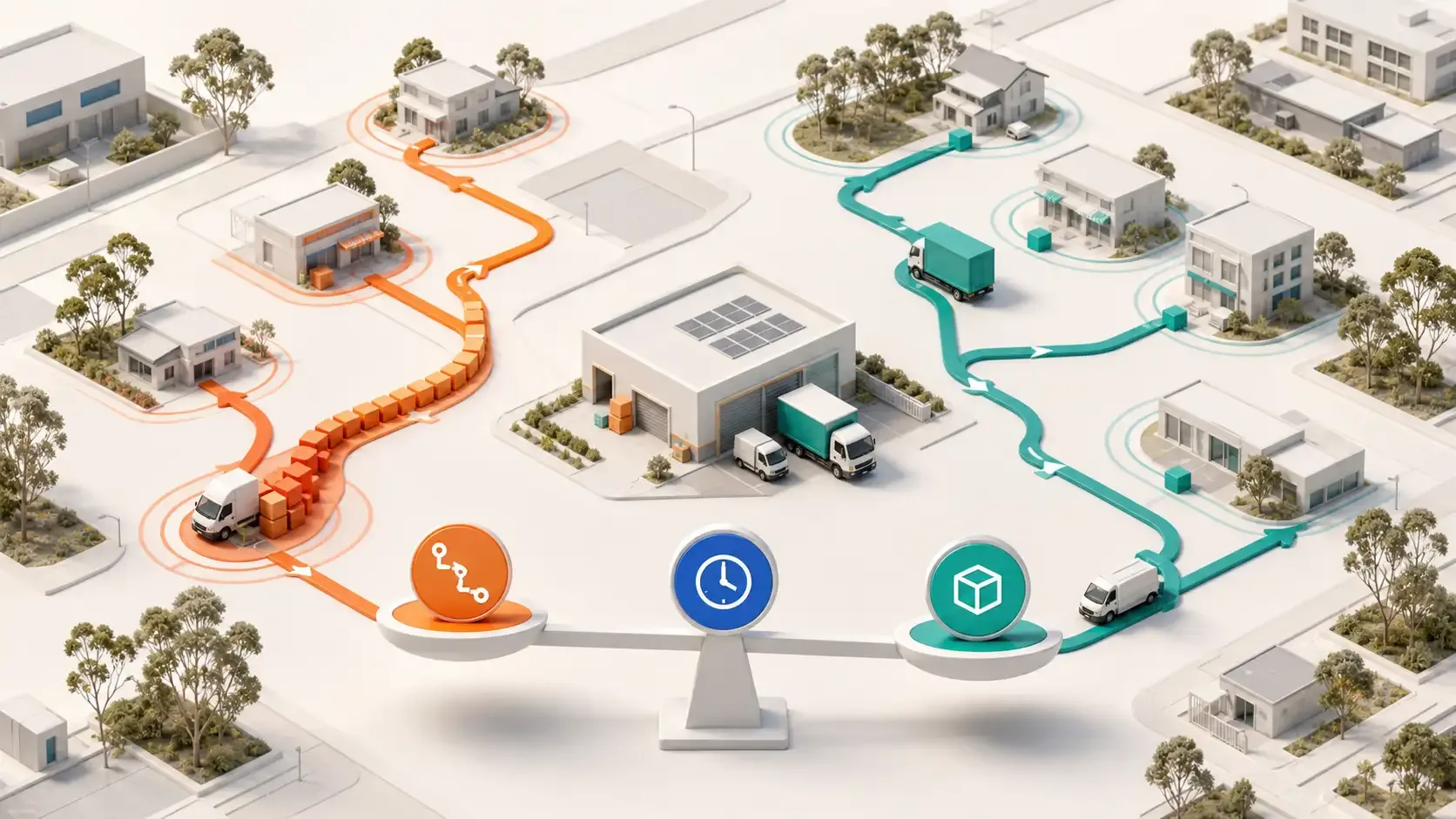
On this page
The shortest line on a map can be surprisingly persuasive.
It looks efficient, uses fewer kilometres and appears easy to explain. For a delivery fleet, however, route distance is only one part of the operating decision.
A shorter route may overload the wrong vehicle, exceed a driver’s working window, create unrealistic service timing or leave important deliveries unassigned. It can even require more operating hours than a slightly longer alternative.
That is why the shortest route and the best optimized route are not always the same.
Australian delivery teams need to compare distance with vehicle capacity, working time, customer time windows, service duration and dispatch practicality before deciding which plan is genuinely more economical.
Shortest Route vs Optimized Route
A shortest-route calculation primarily asks:
> What is the lowest-distance path between these locations?
A practical route optimization system asks a broader question:
> How should this delivery work be allocated and sequenced across the available fleet while respecting operational constraints?
Those constraints can include:
- Vehicle capacity
- Driver and vehicle working hours
- Customer time windows
- Stop service duration
- Depot locations
- Mission priority
- Vehicle or driver skills
- Pickup and delivery relationships
- Route workload
- Unassigned delivery risk
The route with the lowest distance may still perform poorly against several of these requirements.
Real Operational Data Shows the Trade-Off
An anonymized one-day route-planning analysis used real operational data from four depots to compare a recorded baseline with time-focused and distance-focused alternatives.
Planning scenario | Vehicles | Total operating hours | Total distance |
|---|---|---|---|
Recorded baseline | 55 | 530 hours | 3,619 km |
Time-focused plan | 51 | 521 hours | 3,201 km |
Distance-focused plan | 51 | 554 hours | 2,939 km |
The distance-focused plan was the shortest alternative. It travelled 262 fewer kilometres than the time-focused plan.
But it also required 33 additional operating hours.
Compared with the recorded baseline, the distance-focused plan reduced travel by 680 kilometres while increasing total operating time by 24 hours. The time-focused plan reduced both distance and operating hours, although it did not achieve the minimum possible distance.
*Benchmark note: This is an anonymized historical planning analysis, not an Australian case study. The alternative plans were modelled from real operational data and are not audited post-deployment savings. Calculations use the displayed totals. Australian results will vary according to geography, traffic, labour arrangements, fleet mix, service windows and data quality.*
Why Fewer Kilometres Can Require More Time
Distance and time do not move together perfectly.
A lower-distance plan may concentrate more stops into dense areas where parking, customer access and service activities take longer. It may use slower roads, create less balanced workloads or allocate too many service-intensive deliveries to the same route.
A longer route may use faster road connections or distribute work more effectively between drivers.
This distinction matters in Australian operations where one fleet may serve:
- Dense metropolitan delivery areas
- Industrial and commercial zones
- Outer-suburban customers
- Regional routes with long travel legs
- Customers with different receiving hours
- Locations with very different unloading requirements
A kilometre in a regional run does not create the same operating conditions as a kilometre containing several inner-city stops.
The Right Route Depends on Your Cost Structure
A route should be assessed against the costs it actually creates.
Cost driver | What influences it | Useful planning measure |
|---|---|---|
Driver labour | Travel time, service duration, waiting and route workload | Total route hours |
Fuel and maintenance | Distance, vehicle type and driving pattern | Kilometres per completed delivery |
Vehicle requirements | Capacity, working windows and route allocation | Vehicles required per day |
Contractor use | Internal fleet availability and overflow demand | Contracted routes or vehicles |
Failed delivery work | Time-window failures, incorrect assignments and incomplete data | Failed and rescheduled missions |
Planning administration | Manual route building, checking and reassignment | Planning time and manual route edits |
If labour represents a larger cost than distance, saving 262 kilometres while adding 33 hours may be a poor exchange.
If distance-related cost is dominant and the additional hours remain operationally acceptable, the distance-focused plan may be more attractive.
The correct answer depends on local costs. This is why a reduction in route kilometres should never be presented automatically as the same percentage reduction in total delivery cost.
For a deeper look at these relationships, see how dispatch and fleet management decisions influence delivery cost.
Vehicle Capacity Can Make the Shortest Route Impossible
Vehicles cannot be treated as identical points moving around a map.
A separate anonymized operational dataset demonstrates the variation that can exist inside one fleet.
Fleet input | Recorded operational value |
|---|---|
Customer records | 3,931 |
Available vehicles | 55 |
Total listed fleet capacity | 46.6 tonnes |
Approximate average listed capacity | 847 kg |
Vehicle capacity range | 600–6,000 kg |
Daily invoice volume across reviewed dates | 1,418–1,439 |
Reported capacity utilization | 88%–99% |
*Dataset note: These are historical operational planning values. Reported utilization follows the source report’s calculation and should not be interpreted as an Australian result or a guaranteed target.*
The 600–6,000 kg capacity range is especially important. It shows why an optimizer cannot simply assign the nearest available vehicle.
A small vehicle may be geographically close to a group of customers but unable to carry the required load. A large vehicle may have enough capacity but be unnecessarily expensive or unsuitable for particular delivery locations.
Accurate fleet management data allows capacity, availability, working hours, skills and vehicle costs to influence the route plan before dispatch.
Service Time Changes the Meaning of a Short Route
Travel is only one part of a delivery route.
A driver may also spend time:
- Loading at the depot
- Finding the correct customer entrance
- Waiting for access
- Unloading goods
- Confirming delivery
- Managing customer questions
- Completing the mission in the driver workflow
A route containing 25 nearby stops may require more time than a route with 15 stops spread across a larger area.
If service duration is missing or unrealistic, the optimizer may group too much work into a compact route because the locations appear close together.
Clean delivery mission data helps route plans account for service duration, quantities, time windows, priorities and other requirements attached to each stop.
Customer Time Windows Can Override Geography
Suppose three customers are located close together.
The first accepts deliveries during the morning. The second cannot receive goods until early afternoon. The third has a narrow appointment window.
The shortest geographical sequence may create waiting time or a missed window. A route that temporarily moves to another area and returns later could involve more distance but produce a better completion result.
This is one reason route optimization should evaluate customer commitments alongside travel.
The cost of a missed delivery may include:
- A second visit
- Additional customer-service work
- Driver and vehicle time
- Replanning the following day
- Customer dissatisfaction
- Pressure on account managers or sales teams
A slightly longer route that completes the work successfully can therefore be less expensive than a shorter route that creates repeat delivery work.
Workload Balance Matters Across the Whole Fleet
A route should not be judged in isolation.
Moving one stop can make a single route shorter while making another route much longer. Concentrating nearby deliveries into one route can also leave one driver overloaded while another finishes early.
The planning objective should evaluate the complete fleet result:
- Total vehicles required
- Total operating hours
- Total distance
- Workload by route
- Capacity utilization
- Unassigned missions
- Expected completion within working windows
The best route is part of the best overall plan, not necessarily the shortest individual route.
This is why route optimization and fleet management software work better together.
Dispatchers Still Need to Review the Result
Even a well-configured optimization model cannot know every local detail.
A dispatcher may know that a particular entrance is difficult for a large vehicle, a customer usually needs additional unloading time or a road creates problems during a certain part of the day.
The dispatcher map gives operators a place to review route geometry, distance, duration, ETAs, stop order and driver or vehicle assignments before sending routes to the field.
A practical review should ask:
- Does every route fit the assigned vehicle?
- Are workloads balanced between drivers?
- Do route durations fit the available working windows?
- Are customer time windows practical?
- Is any high-priority work unassigned?
- Does the stop order reflect important local knowledge?
- Is the shortest plan actually the best cost and service plan?
Optimization should reduce manual calculation while preserving informed dispatcher control.
Choosing the Right Planning Objective
Different delivery days may require different priorities.
Distance-focused planning
This can be useful when distance-related vehicle costs are especially important and working time remains acceptable.
Time-focused planning
This can be valuable when labour availability, overtime or route completion time is the main constraint.
Vehicle-focused planning
This may help when contractor use, fleet availability or the number of routes is the primary concern.
Balanced planning
Many operations need to consider distance, time, vehicles, capacity and customer commitments together.
The planning objective should reflect the business problem being solved. Selecting “minimum distance” by default can hide a more expensive outcome elsewhere in the operation.
Build a Repeatable Route-Selection Process
Australian delivery teams can use a consistent process to compare alternative plans:
- Keep active vehicle, capacity, skill and working-hour data current.
- Import missions with accurate locations, quantities, service durations and time windows.
- Generate route plans using the available fleet and depot context.
- Compare total distance, hours, vehicle count and unassigned work.
- Review workload and stop order before dispatch.
- Assign the appropriate driver and vehicle.
- Send the approved routes to the field.
- Monitor exceptions during delivery execution.
- Compare planned and completed performance.
- Revise route settings and data for the next planning cycle.
After dispatch, the driver mobile app keeps route and mission context connected to field execution.
Managers can then use route, driver, mission and fleet reports to identify whether the selected planning objective produced the intended result.
Metrics to Review Beyond Distance
Distance remains useful, but it needs context.
A balanced route review can include:
- Kilometres per completed delivery
- Total operating hours
- Average route duration
- Missions per vehicle
- Vehicle capacity utilization
- Planned versus completed missions
- Failed or rescheduled deliveries
- Unassigned missions
- Manual route changes
- Overtime or contractor use
- Cost per completed delivery
Reviewing these measures over several planning cycles creates a more reliable picture than judging one route by its appearance on a map.
Software Reduces Dependence on One Routing Expert
Experienced routing and dispatch professionals understand trade-offs that are difficult to capture in a simple spreadsheet.
Recruiting that expertise can take time, and relying on one person creates operational risk when knowledge is not recorded.
Route optimization software can standardize many repeatable decisions by applying vehicle, mission, time-window and working-hour constraints consistently. It gives other team members a structured starting point and makes alternative plans easier to compare.
It does not eliminate the need for operational judgement. Instead, it allows experienced people to focus on exceptions, customer requirements and improvement rather than calculating every route manually.
Find the Route That Works, Not Just the One That Looks Short
The shortest route can be useful, but it should not become the only definition of efficiency.
The strongest delivery plan balances kilometres with operating hours, vehicle capacity, customer commitments and the probability of completing every assigned mission.
Start with your own fleet and delivery data. Compare alternative plans, review the trade-offs and measure what happens after dispatch.
Start free with Rouptimize and evaluate whether your shortest route is also your best operational route.
Written by
Results-oriented and visionary CEO with a passion for innovation and a track record of transforming startups into industry leaders. Seeking a leadership role in a dynamic startup environment where I can leverage my strategic acumen, entrepreneurial spirit, and hands-on experience to drive growth, build high-performing teams, and deliver unparalleled value to customers. Committed to fostering a culture of creativity, adaptability, and sustainable success.
Operations • Management • Route Optimization • Product Management • Logistics • Problem Solving
FAQ
Is the shortest route always the cheapest delivery route?
No. A shorter route can require more driver hours, unsuitable vehicles, additional waiting or failed deliveries. Total cost should be assessed across time, distance, vehicles and completion performance.
What is the difference between a shortest route and an optimized route?
A shortest route mainly minimises distance. An optimized route can also account for vehicle capacity, time windows, service duration, depots, working hours, skills, priorities and fleet-wide workload.
Why can a lower-distance route take longer?
It may include more stops, slower roads, longer service activities, waiting time or an imbalanced workload. Distance and operating duration are related, but they are not interchangeable.
Should Australian fleets optimise for time or distance?
The right objective depends on local labour, vehicle, fuel, maintenance and service costs. Teams should compare complete planning scenarios using their own data.
Can route optimization improve customer satisfaction?
More practical routes can help teams meet time windows, avoid preventable capacity problems and respond to exceptions earlier. The result still depends on data quality, execution and operational discipline.
Does route optimization replace dispatcher knowledge?
No. It automates complex calculations and applies recorded constraints consistently. Dispatchers still provide local knowledge, review unusual routes and manage daily exceptions.