Route Optimization and Fleet Management Software: Why Australian Delivery Teams Need Both
Route optimization plans how delivery work should move, while fleet management defines which vehicles and drivers can complete it. Connecting both gives Australian delivery teams more practical routes, clearer dispatch decisions and better control over delivery costs.
 Mohammad AlavitabarCEO @ Rouptimize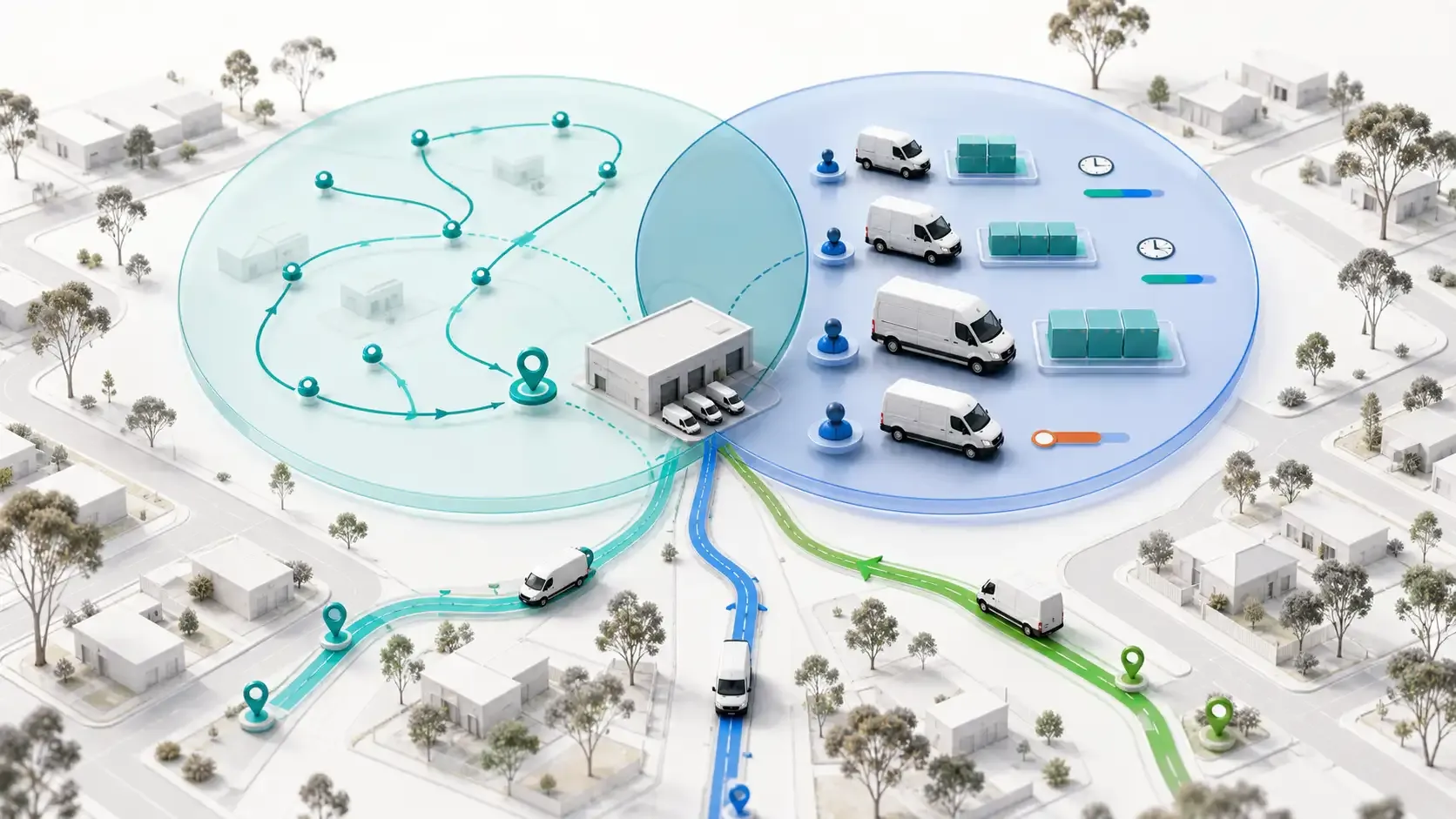
On this page
Route optimization and fleet management are often treated as separate software categories.
One plans the route. The other stores information about vehicles and drivers.
In a real delivery operation, however, they solve two parts of the same problem.
A route cannot be practical unless it matches the vehicles, drivers, capacities and working hours available that day. A well-maintained fleet database does not reduce delivery costs by itself unless that information influences route planning and dispatch.
For Australian delivery teams working across dense metropolitan areas, outer suburbs and regional routes, connecting these systems can make the difference between a route that looks efficient and one that can actually be completed.
Route Optimization and Fleet Management Answer Different Questions
Route optimization software determines how delivery work should be organised across available routes.
It considers questions such as:
- Which stops should be grouped together?
- What sequence should the driver follow?
- Which depot should the route start or finish at?
- Can customer time windows be respected?
- How much distance and duration does the plan involve?
- Which missions cannot be assigned under the current constraints?
Fleet management for route planning provides the operational facts behind those decisions.
It answers questions such as:
- Which vehicles are active today?
- What weight or volume can each vehicle carry?
- Which drivers and vehicles are assigned?
- What working hours apply?
- Does the vehicle have the required skills or characteristics?
- What operating costs should influence the plan?
Dispatch connects the two. It turns an optimized plan and an available fleet into assigned, driver-ready work.
System | Primary question | Important inputs | Operational output |
|---|---|---|---|
Route optimization | How should today’s work be divided and sequenced? | Missions, locations, time windows, service duration, depots and priorities | Planned routes and unassigned exceptions |
Fleet management | Which resources can complete the work? | Vehicles, drivers, capacity, skills, availability, working hours and costs | Route-ready fleet information |
Dispatch software | Who will complete each route, and what needs adjustment? | Route results, driver and vehicle assignments, stop order and exceptions | Reviewed routes sent to the correct drivers |
When these systems are disconnected, dispatchers have to join the information manually. That often means switching between spreadsheets, fleet records, maps and driver messages before a route can leave the depot.
Why Route Optimization Needs Accurate Fleet Data
A routing engine can only work with the constraints it receives.
If every vehicle is treated as identical, the software may create a mathematically efficient plan that does not reflect the real fleet.
Vehicle capacity changes route feasibility
A van may have enough weight capacity but insufficient physical space. A larger vehicle may carry more deliveries but be unsuitable for a particular site or operating area.
Capacity therefore affects:
- Which missions can travel together
- How many routes are required
- Which vehicle should receive each route
- Whether last-minute load changes are necessary
- Whether work remains unassigned
The practical relationship between routes and capacity is explored further in Rouptimize’s vehicle capacity route-planning guide.
Working hours affect the number of usable routes
A vehicle and driver may be available for only part of the day. A route that exceeds that operating window could create overtime, unfinished deliveries or an emergency reassignment.
Working hours should influence the plan before dispatch, not appear as a problem after the driver has left.
Fleet status affects daily availability
Inactive vehicles, maintenance requirements and unavailable drivers can change the route plan immediately.
If fleet availability is stored in one system but routes are created somewhere else, dispatchers may build plans around resources they cannot use.
Skills and vehicle characteristics affect assignment
Some work may require a particular vehicle type, equipment or driver capability. These requirements need to remain connected to the mission and vehicle records used during planning.
What Operational Data Shows
Historical delivery data helps illustrate why route planning and fleet decisions should be reviewed together.
The following anonymised six-day operational comparison used real delivery data to compare existing operations with an optimized planning model.
Metric | Existing operation | Optimized planning result | Calculated change |
|---|---|---|---|
Average missions per vehicle | 18 | 21 | 16.7% higher |
Average working time per vehicle | 436 minutes | 294 minutes | 32.6% lower |
Average distance per vehicle | 56 km | 44 km | 21.4% lower |
Vehicles used during the reporting period | 64 | 55 | 14.1% fewer |
*Percentages were calculated from the displayed benchmark values and rounded to one decimal place.*
This table does not represent an Australian customer case study or guarantee that every operation will produce the same result. It is an anonymised historical benchmark showing how route and fleet decisions can influence several measures at the same time.
Australian results will depend on delivery density, traffic conditions, service durations, customer windows, fleet mix, driver availability and the quality of the underlying data.
The important lesson is not one percentage. It is the relationship between the measures.
More missions were allocated per vehicle while average distance and working time were lower. The model also used fewer vehicles over the comparison period. Those outcomes were evaluated together rather than treating route distance as the only objective.
Fleet Data Determines What Optimization Can Test
A separate anonymised planning dataset shows the amount of operational context that may sit behind a route plan.
Planning input | Recorded value | Why it mattered |
|---|---|---|
Customer records | 3,931 | Created a structured base for locations and delivery requirements |
Available vehicles | 55 | Defined the fleet that could participate in planning |
Total listed capacity | 46.6 tonnes | Established the combined carrying limit |
Average listed vehicle capacity | 847 kg | Helped evaluate workload distribution |
Vehicle capacity range | 600–6,000 kg | Showed why vehicles could not be treated as interchangeable |
Daily invoice volume | 1,418–1,439 | Established the scale of delivery work across the reviewed dates |
Missions per vehicle | 28–32 | Helped compare route workload |
Reported capacity utilisation | 88%–99% | Made vehicle loading visible during planning |
The dataset also included customer groups, delivery time windows, stop durations, invoice weights and vehicle working hours.
These details demonstrate why clean fleet and mission data matter. Optimization cannot account for a constraint that has not been recorded.
How Connected Software Can Affect Delivery Costs
Delivery cost is not controlled by one metric.
A shorter route may reduce kilometres while requiring more vehicles. A plan with fewer vehicles may increase driver hours. A highly utilised vehicle may still receive an unrealistic stop sequence.
Route optimization, fleet management and dispatch software allow managers to examine these trade-offs together.
Distance-related costs
Reducing avoidable kilometres can reduce exposure to:
- Fuel consumption
- Tyre wear
- Maintenance
- Vehicle depreciation
- Driver travel time
Distance should still be reviewed alongside completed deliveries and route workload. A low-distance route is not successful if important missions remain unassigned.
Labour-related costs
Driver working time includes more than travel. It can include loading, parking, customer access, service time, waiting and completion activities.
Accurate stop duration and working-hour data help managers understand whether a route fits within the available shift.
Daily vehicle requirements
Using fewer vehicles for a particular delivery day does not automatically mean vehicles should be removed from the fleet.
It may instead help the business:
- Reduce reliance on overflow vehicles
- Avoid unnecessary contractor use
- retain capacity for peak periods
- Delay an additional vehicle purchase
- Allocate available vehicles to other work
Planning and administration
Disconnected planning creates its own operating cost.
Dispatchers may spend time rebuilding order files, checking vehicle availability, moving stops between drivers and explaining changed routes through calls or messages.
A connected import-to-dispatch workflow reduces the need to recreate the same plan in several places.
Failed service and customer costs
An overloaded vehicle, missed time window or unclear assignment can create more than a route problem.
It may lead to:
- Repeat delivery work
- Additional customer-service contact
- Refund or redelivery pressure
- Lower customer confidence
- More effort from account managers or sales teams
The historical benchmarks do not directly measure marketing or sales savings. Those effects should be treated as potential downstream benefits of more reliable delivery operations, not guaranteed cost reductions.
Better Fleet-Aware Routes Can Improve Customer Satisfaction
Customers do not see the route-planning process. They experience its result.
A practical route can help a delivery team:
- Meet delivery windows more consistently
- Avoid preventable vehicle-capacity problems
- Give drivers clearer assignments
- Respond to exceptions sooner
- Maintain more reliable delivery records
After routes are dispatched, a connected driver delivery app gives field teams access to assigned routes, mission details, navigation, status updates and completion steps.
Live delivery monitoring then helps dispatchers see current route context and respond when active work needs attention.
Finally, code-based proof of delivery connects customer confirmation with the mission record.
Together, these steps make customer experience part of the operating workflow rather than a separate promise made by the sales or marketing team.
Does Software Remove the Need for a Routing Expert?
Route planning expertise can be difficult to recruit and takes time to develop.
Experienced dispatchers often carry valuable knowledge about customers, loading conditions, difficult locations, driver capabilities and local operating patterns.
Software can reduce dependence on one person performing every calculation manually. It can standardise repeatable planning work, retain structured operating data and make route decisions easier for other team members to review.
It should not remove human judgement.
Dispatchers still need to assess unusual customer requirements, safety concerns, missing information and same-day changes. This is why Rouptimize keeps dispatcher control available after optimization.
Using the dispatcher map, operators can review route geometry, ETAs, distance, duration, assignments and stop order before sending work to drivers.
The strongest model combines software consistency with practical operational knowledge.
A Connected Route and Fleet Workflow
Australian delivery teams can connect route optimization and fleet management through a repeatable daily process:
- Keep vehicle status, capacity, skills, working hours and cost information current.
- Import or create delivery missions with accurate location, time-window and service-duration data.
- Select the relevant branch, date, missions and active vehicles.
- Generate routes using the available fleet and operating constraints.
- Review route workloads, stop order and unassigned missions.
- Adjust the plan where dispatcher knowledge adds important context.
- Assign the correct driver and vehicle before dispatch.
- Send the final route to the driver workflow.
- Monitor active work and manage exceptions.
- Review route, driver, mission and fleet results after completion.
This creates a continuous operating loop. Fleet data improves routes, route execution improves reports, and reports help managers improve future fleet and dispatch decisions.
Metrics Australian Delivery Teams Should Review
A connected platform makes it easier to evaluate the complete delivery operation rather than one isolated number.
Useful measures include:
- Cost per completed delivery
- Kilometres per completed mission
- Average route duration
- Missions per vehicle
- Vehicle capacity utilisation
- Driver working time
- Late or unsuccessful deliveries
- Unassigned missions
- Manual route changes
- Vehicle and driver activity
Rouptimize’s reports and analytics keep route, mission, driver and fleet activity close to the operational workflow.
Managers can then use those findings to adjust fleet availability, mission data, working hours, service durations or route-planning decisions.
Questions to Ask Before Choosing Software
When comparing route optimization and fleet management software, Australian delivery teams should ask:
- Can vehicle capacity and working hours influence route planning?
- Can inactive or unavailable vehicles be excluded?
- Can routes use branch and depot context?
- Can dispatchers review and adjust the result?
- Can drivers and vehicles be assigned within the same workflow?
- Can drivers receive updated route information through a mobile app?
- Can managers review route, driver, mission and fleet performance together?
- Can the operation retain its data and improve future decisions?
A platform is more valuable when the information entered during fleet setup continues to influence planning, dispatch and reporting.
Connect Routes, Fleet and Dispatch Decisions
Route optimization determines how delivery work should move. Fleet management defines the resources available to move it. Dispatch turns both into an executable plan.
When these functions share the same operational data, Australian delivery teams can build routes that are easier to review, assign and complete.
The goal is not simply to draw shorter routes. It is to make better decisions about distance, time, vehicles, drivers, capacity and customer commitments together.
For a broader view of the financial impact, read how routes, reports and driver workflows can help control delivery costs in Australia.
When your team is ready to connect fleet setup, route planning, dispatch and performance reporting, start with Rouptimize.
Written by
Results-oriented and visionary CEO with a passion for innovation and a track record of transforming startups into industry leaders. Seeking a leadership role in a dynamic startup environment where I can leverage my strategic acumen, entrepreneurial spirit, and hands-on experience to drive growth, build high-performing teams, and deliver unparalleled value to customers. Committed to fostering a culture of creativity, adaptability, and sustainable success.
Operations • Management • Route Optimization • Product Management • Logistics • Problem Solving
FAQ
Is route optimization the same as fleet management?
No. Route optimization determines how delivery work should be grouped and sequenced. Fleet management maintains the vehicle, driver, capacity, availability, working-hour and cost information that makes those plans practical.
Do Australian delivery teams need both systems?
Teams managing multiple vehicles, drivers or daily routes usually benefit when route planning uses current fleet information. The systems do not necessarily need to be separate products, but their functions should remain connected.
Can route optimization reduce delivery costs?
It can help reduce avoidable distance, working time, vehicle use and planning effort. Actual financial results depend on the operation, input data, local costs and how consistently the resulting workflow is used.
Does route optimization always choose the shortest route?
Not necessarily. Practical optimization may also consider vehicles, depots, time windows, capacity, working hours, skills, priorities and service duration.
What fleet data is needed for route planning?
Useful fleet data includes vehicle status, capacity, skills, working hours, operating costs, branch, depot context and driver assignments.
Will software replace experienced dispatchers?
No. Software can automate calculations and standardise repeatable work, but dispatchers still provide local knowledge, operational judgement and exception management.