Dispatch Software and Fleet Management: How Connected Operations Control Delivery Cost
Dispatch software coordinates the delivery day, while fleet management keeps vehicle, driver, capacity and availability data current. Connecting both helps Australian operators control the decisions that shape delivery cost.
 Mohammad AlavitabarCEO @ Rouptimize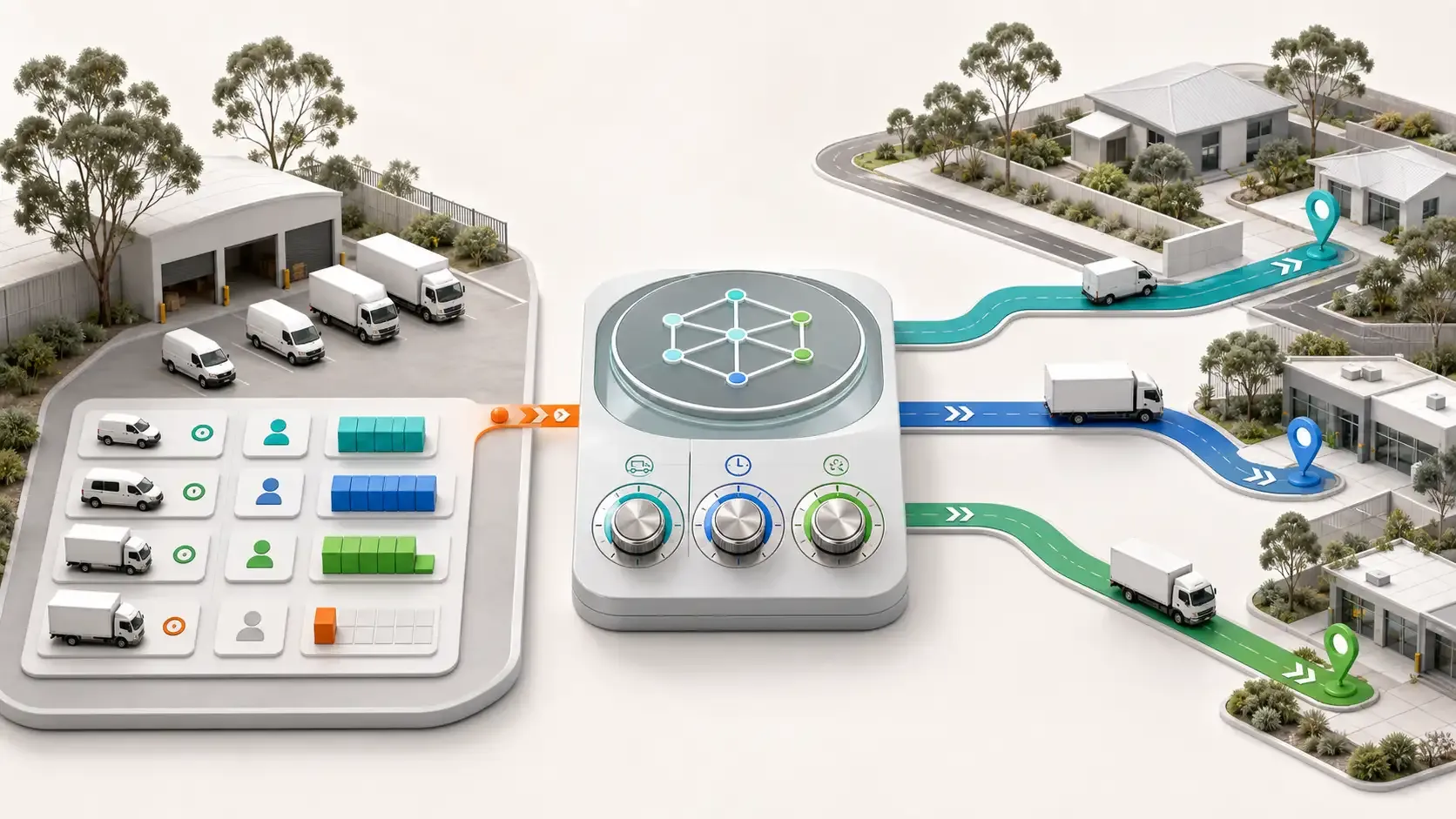
On this page
Delivery costs do not begin at the fuel pump. Many of them are created before a vehicle leaves the depot.
The vehicles selected for the day, the work assigned to each driver, the order of the stops and the accuracy of delivery data all influence how much capacity, time and distance an operation consumes.
This is why dispatch software and fleet management should not operate as separate information islands. Fleet management provides an accurate view of the resources available, while dispatch and route optimization decide how those resources should be used.
When those decisions remain connected, Australian delivery teams can control avoidable cost without sacrificing the service customers expect.
Fleet management and dispatch software answer different questions
Fleet management establishes the operational truth about vehicles and drivers. Dispatch software turns that information into decisions for the current delivery day.
Route optimization sits between them, using delivery requirements and available fleet resources to build practical routes.
System | Operational question | Important data | Cost exposure when disconnected |
|---|---|---|---|
Fleet management | Which resources can operate today? | Vehicle availability, capacity, skills, costs, drivers and working hours | Inactive or unsuitable vehicles may enter the plan |
Mission management | What work must be completed? | Locations, service times, item quantities, priorities and time windows | Routes may be based on incomplete or inconsistent orders |
Route optimization | How should the work be allocated and sequenced? | Missions, depots, vehicles, constraints and planning objectives | More vehicles, distance or working time may be used than necessary |
Dispatch software | Who will complete each route, and what needs attention? | Route assignments, ETAs, stop order, exceptions and live status | Problems may remain hidden until drivers are already on the road |
Rouptimize connects these operational layers through fleet management, mission management, route planning and dispatch workflows.
Whether fleet information is maintained in Rouptimize or another fleet system, the route planner still needs a current operational view of vehicle availability, capacity, working windows and driver assignments.
Where disconnected operations create delivery cost
A route can look acceptable on a map while still being expensive to operate.
Common sources of avoidable cost include:
- A vehicle under maintenance remaining available to the planner
- Small vehicles receiving loads that require later reassignment
- Driver or vehicle working windows being out of date
- Dispatchers rebuilding routes across spreadsheets and mapping tools
- Unassigned work being discovered shortly before departure
- Late delivery changes not reaching the assigned driver
- Failed deliveries being separated from the route and mission reports
Each issue may appear small. Repeated across hundreds of deliveries, however, it can increase planning effort, driving distance, overtime exposure and redelivery work.
Teams moving away from fragmented processes can also review when manual dispatch should give way to route optimization.
What real operational planning data shows
An anonymised historical benchmark compared a recorded one-day delivery operation across four depots with three alternative planning scenarios.
The scenarios were created from real operational data, but they represent modelled route plans rather than audited post-deployment savings.
Planning scenario | Vehicles | Total hours | Total distance | Change from baseline |
|---|---|---|---|---|
Recorded baseline | 55 | 530 | 3,619 km | Baseline |
Time-focused plan | 51 | 521 | 3,201 km | Vehicles -7.3%; hours -1.7%; distance -11.6% |
Distance-focused plan | 51 | 554 | 2,939 km | Vehicles -7.3%; hours +4.5%; distance -18.8% |
Longer vehicle-availability scenario | 47 | 519 | 3,101 km | Vehicles -14.5%; hours -2.1%; distance -14.3% |
*Benchmark note: Percentages were calculated from the displayed totals and rounded. This is an anonymised planning analysis, not an Australian case study or a guarantee of cost reduction. Results in Australia will vary according to geography, traffic, labour costs, fleet mix, delivery density, service windows and data quality.*
The lowest-distance plan is not automatically the lowest-cost plan
The comparison reveals an important operational trade-off.
The distance-focused scenario produced the largest reduction in kilometres, but total operating hours increased by approximately 4.5%. If labour and overtime are major cost drivers, that plan may not produce the best overall financial result.
The time-focused scenario achieved a smaller distance reduction while also slightly reducing operating hours. The longer-availability scenario used the fewest vehicles, but it would only be practical where the proposed vehicle and driver working windows were genuinely available.
There is no universal optimization objective that works for every delivery operation. The right plan depends on the relative cost of:
- Driver and vehicle time
- Fuel, tolls and distance-related maintenance
- Owned vehicles and contracted capacity
- Overtime or additional shifts
- Failed deliveries and repeat visits
- Customer time-window commitments
A large percentage reduction in kilometres should not be presented as the same percentage reduction in total delivery cost. Distance is one cost driver, not the complete cost model.
How connected systems improve vehicle utilization
Accurate fleet data helps the route optimization software build routes around vehicles that can actually perform the work.
Capacity, skills, depot assignments, working hours and availability can all affect which vehicle should receive a mission. When that information is incomplete, planners may create routes that require manual repair immediately after optimization.
Connected fleet and dispatch workflows also make it easier to distinguish between reducing the number of vehicles required for one day and achieving a genuine financial saving.
Using fewer vehicles may immediately reduce contractor hire or additional shifts. For an owned fleet, it may initially create spare capacity rather than cash savings. Longer-term savings depend on how that capacity affects fleet replacement, growth and procurement decisions.
Dispatch review remains essential
Optimization should produce a strong starting plan, but dispatchers still need to examine whether it makes sense operationally.
On the Rouptimize dispatcher map, operators can review route geometry, stop order, distance, duration, ETAs and driver or vehicle assignments before dispatch.
They can identify overloaded routes, unusual stop sequences, unassigned missions or workloads that do not reflect local knowledge. Necessary changes can then be made while the plan is still under dispatcher control.
This combination is more practical than treating either software or human judgement as sufficient on its own.
The connection must continue after dispatch
Cost control does not end when routes are sent to drivers.
The driver delivery app keeps assigned missions and route context available in the field. Live delivery monitoring helps dispatchers identify exceptions without repeatedly contacting every driver.
A lightweight proof-of-delivery process can then connect customer confirmation and final delivery status to the original mission record.
When planning, execution and completion data remain connected, managers can identify whether a problem originated in the route plan, fleet assignment, driver workflow or customer interaction.
A repeatable connected workflow
A practical daily workflow can follow these steps:
- Update active vehicles, maintenance status, capacities and working windows.
- Import or create delivery missions with accurate locations, quantities and time windows.
- Select the vehicles and depots available for that planning period.
- Generate routes using objectives that reflect the operation’s real cost priorities.
- Review workloads, stop order, ETAs and exceptions before dispatch.
- Assign drivers and vehicles to approved routes.
- Send routes to drivers and monitor meaningful exceptions during execution.
- Compare planned and completed work through delivery reports and analytics.
- Revise fleet settings, mission data or planning decisions for the next cycle.
This creates a decision loop rather than a one-time optimization exercise. Over time, the accumulated data can help the operation make better decisions than competitors still rebuilding each day from spreadsheets and individual experience.
Metrics that connect planning decisions to cost
Australian delivery operators should define a small set of consistent measures rather than collecting reports without a decision process.
Useful metrics include:
- Cost per completed delivery
- Kilometres per completed mission
- Planned and actual route duration
- Missions completed per active vehicle
- Vehicle capacity utilization
- Overtime or contractor capacity used
- Unassigned, failed and rescheduled missions
- Manual route edits and late reassignments
- Redelivery rate and customer complaints
Operational reports should also be combined with finance and customer-service data. Route reports alone cannot prove a reduction in marketing or sales costs.
However, more reliable deliveries may reduce complaint handling, repeat delivery pressure and customer churn. If service reliability improves retention or referrals, the business may face less pressure to continually replace dissatisfied customers through new sales and acquisition spending.
Does software remove the need for a routing expert?
Experienced dispatchers remain valuable because they understand customers, local roads, loading constraints and the realities of the fleet.
The role of software is to make that knowledge more repeatable.
Instead of relying on one person to remember every vehicle capacity, time window and delivery rule, teams can store important constraints in the planning workflow. This reduces dependence on scarce routing expertise and gives new dispatchers a stronger operational starting point.
Human judgement then focuses on exceptions and improvement rather than manually constructing every route.
Applying the approach in Australian delivery operations
Australian delivery networks can contain very different planning conditions within the same business.
Dense metropolitan routes may be shaped by time windows, loading access and stop service duration. Outer-suburban deliveries may place more weight on distance and schedule reliability. Regional work can involve fewer stops but much longer travel legs.
That is why Australian operators should evaluate dispatch software using their own missions, vehicles, service commitments and cost structure.
A representative trial should compare vehicles required, route hours, kilometres, unassigned work and expected completion performance. The objective is not to produce the shortest-looking route. It is to produce a plan the business can execute at an acceptable cost.
For a broader view, read how route optimization and fleet management work together for Australian delivery teams.
Turn connected data into a measurable planning cycle
Delivery cost becomes easier to control when fleet data, route decisions, dispatch execution and performance reports describe the same operation.
Start with a representative depot or delivery day. Establish the baseline, generate alternative plans and compare vehicles, hours, distance and service constraints before changing the wider operation.
Start free with Rouptimize and evaluate your delivery plans using your own operational data.
Written by
Results-oriented and visionary CEO with a passion for innovation and a track record of transforming startups into industry leaders. Seeking a leadership role in a dynamic startup environment where I can leverage my strategic acumen, entrepreneurial spirit, and hands-on experience to drive growth, build high-performing teams, and deliver unparalleled value to customers. Committed to fostering a culture of creativity, adaptability, and sustainable success.
Operations • Management • Route Optimization • Product Management • Logistics • Problem Solving
FAQ
Is dispatch software the same as fleet management software?
No. Fleet management maintains information about vehicles, drivers, availability and operating constraints. Dispatch software coordinates delivery work, route assignments and daily execution. They become more valuable when their data remains connected.
Can connecting dispatch and fleet management reduce delivery costs?
It can help control cost drivers such as unnecessary distance, poor vehicle utilization, planning effort, overtime exposure and failed deliveries. The financial result depends on the operation’s baseline, cost structure and ability to implement the proposed routes.
Should a delivery team optimise for time or distance?
The correct objective depends on local costs and service commitments. Minimising distance may increase working time, while minimising time may require additional kilometres or vehicles. Teams should compare complete planning scenarios rather than one metric.
Does route optimisation replace dispatchers?
No. It reduces repetitive calculation and makes operational constraints easier to apply consistently. Dispatchers still review plans, manage exceptions and contribute local knowledge.
What data should be connected before route planning?
Start with accurate mission locations, service duration, quantities, time windows, vehicle capacity, availability, driver working windows, depot assignments and required skills.