Pickup and Delivery Route Planning: Why Two-Point Jobs Need Better Workflow Control
Pickup and delivery jobs require more than a standard delivery route. This guide explains how Australian teams can plan linked collection and destination stops with better control over timing, capacity and dispatch.
 Mohammad AlavitabarCEO @ Rouptimize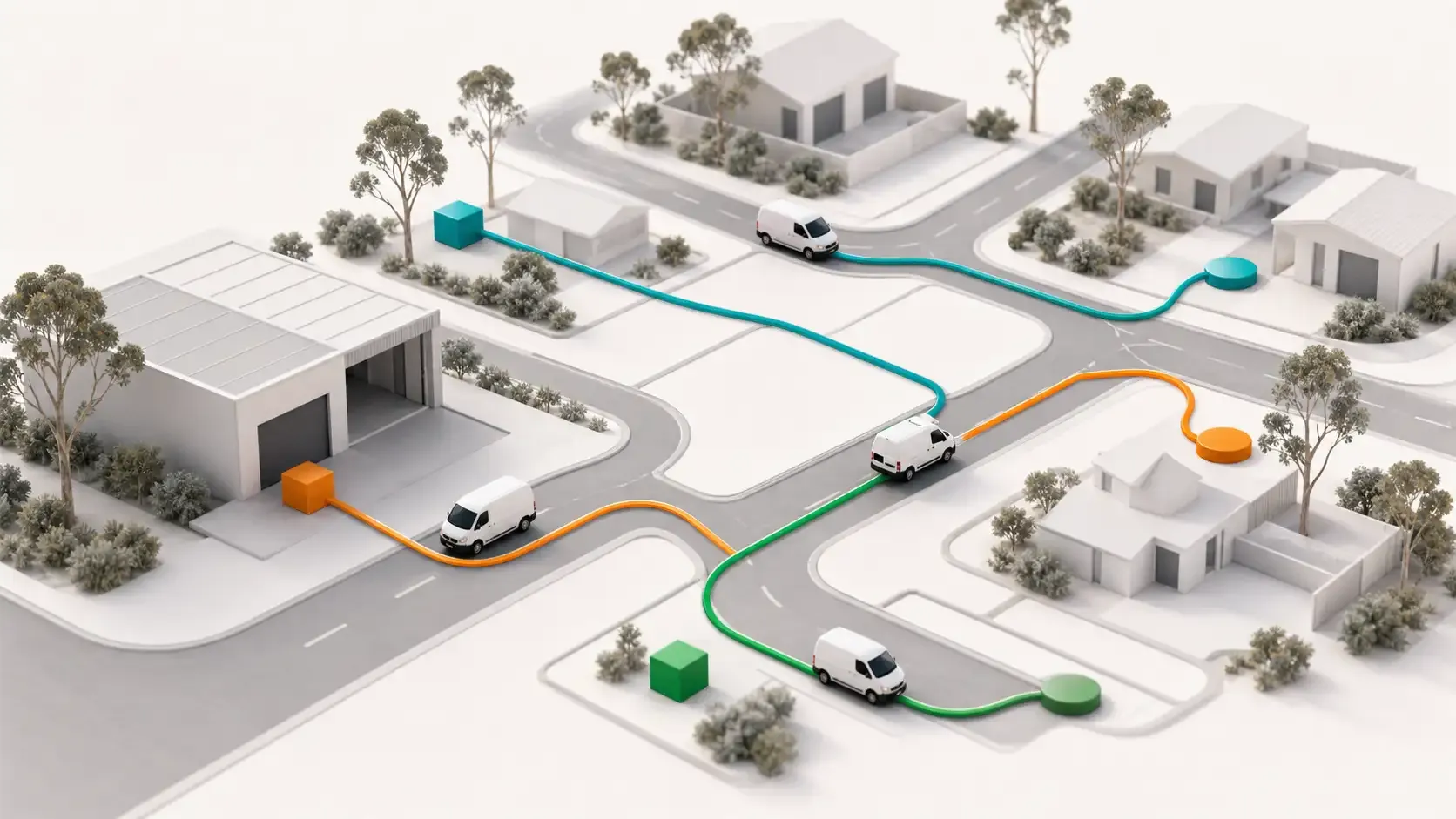
On this page
A standard delivery usually has one main service location.
A pickup-delivery job has two: where the item enters the vehicle and where it must leave.
That difference may sound small, but it changes how the entire route needs to be planned. The pickup must happen first, both locations may have their own time windows, vehicle capacity changes during the job, and the same assignment needs to remain visible from collection through delivery.
When these two stops are managed as unrelated addresses, dispatchers can produce a route that looks efficient on a map but does not work operationally.
For Australian courier, retail, equipment and service businesses, reliable pickup and delivery route planning requires more than connecting nearby points. It requires control over the relationship between each collection and its destination.
A Pickup and Delivery Job Is One Connected Commitment
The easiest way to understand a two-point job is to treat it as one operational commitment with two linked actions.
The driver must collect the correct item from the pickup location, carry it through the route and complete the corresponding delivery. The two stops cannot be assigned independently without considering their sequence and operational relationship.
This is different from planning a list of ordinary deliveries. A route planner must understand:
- which pickup belongs to which delivery;
- that collection must happen before drop-off;
- whether the same vehicle can complete both stops;
- how the collected load affects vehicle capacity;
- the time window at each location;
- the service time required for collection and delivery; and
- what information the driver needs at each stage.
Rouptimize supports these relationships through structured pickup-delivery missions, keeping the collection and destination details within the same delivery workflow.
Why Treating the Stops Separately Creates Problems
Imagine a courier has three morning jobs. Each job includes a collection from one business and delivery to a different customer.
If the six addresses are planned only by proximity, the route may send the driver past a delivery location before the related item has been collected. The route might also collect several large items early, even though the assigned vehicle cannot carry them together.
A dispatcher can correct these problems manually, but the workload grows quickly. Five pickup-delivery jobs create ten stops and five sequence relationships. Twenty jobs create forty stops, twenty relationships, multiple capacity changes and potentially forty different service windows.
The difficulty is not simply finding the shortest route. It is preserving the operational logic of every job while building a workable plan across the whole fleet.
The Constraints That Matter Most
Pickup must come before delivery
The most basic rule is also the most important. The delivery stop cannot be completed before its linked pickup.
This relationship needs to remain intact during optimization, route review, driver assignment and any later adjustment. If a job moves to another route, both sides of the work must still be considered.
Each location can have a different time window
A supplier may allow collections between 8:00 am and 10:00 am, while the receiving customer may only be available after midday.
The route must satisfy both conditions in the correct order. This is why delivery time windows need to be captured as planning constraints rather than left in dispatcher notes.
Collection changes vehicle capacity
A vehicle may begin the day empty, collect several items and gradually use its available capacity. It may then free capacity as those items are delivered.
This changing load makes pickup-delivery work more complex than a route where the entire load leaves from one depot. Weight, volume and item count should be considered when assigning work to a vehicle.
For a deeper look at this constraint, see the guide to vehicle capacity route planning.
Pickup and delivery require different service times
Collection may involve checking goods, waiting for warehouse staff or loading equipment. Delivery may require unloading, customer confirmation or access to a receiving area.
Using one generic duration for both stops can create unrealistic ETAs. Recording pickup duration and delivery duration separately helps the route plan reflect the work drivers actually perform.
Driver and vehicle suitability still matter
Some jobs may require a particular vehicle capacity, equipment type or driver skill. These requirements must be evaluated together with the pickup-delivery sequence.
A geographically convenient vehicle is not necessarily the right vehicle if it cannot carry or service the job correctly.
Start With Structured Mission Data
Reliable planning begins before optimization. Dispatchers need a consistent mission record for each two-point job.
Useful information includes:
- pickup address and coordinates;
- delivery address and coordinates;
- pickup and delivery time windows;
- pickup and delivery service duration;
- customer and contact details;
- item count, weight and volume;
- priority and required skills; and
- branch, date and assignment context.
Rouptimize’s mission management workflow keeps these details connected so operators can create, import, review and assign delivery work without rebuilding it in separate tools.
Teams introducing the process for the first time can also follow the practical tutorial for creating a pickup-delivery job.
Build Routes Around the Full Job
Once the mission data is ready, route optimization can evaluate pickup-delivery work alongside available vehicles, operating windows, depots, capacities, skills and priorities.
The objective is not to place each job on the nearest route independently. It is to create a route where every pickup and its corresponding delivery fit into a practical sequence.
Rouptimize’s route optimization tools allow dispatchers to select missions and active vehicles, define the operating window, include optional depots and generate routes around the recorded constraints.
This becomes especially valuable when the same fleet handles a combination of ordinary deliveries and pickup-delivery missions. Both types of work need to fit within the driver’s available day without losing their different operational requirements.
Review Before Dispatch
Optimized routes should still be reviewed by the dispatch team.
The dispatcher may know that a particular loading dock becomes congested in the morning, that one customer needs additional handling time or that a driver is already carrying equipment for another job.
The dispatcher map provides a workspace for reviewing route details, stop order, mission placement, vehicle assignments and driver assignments before the plan is dispatched.
This stage combines systematic planning with local operational knowledge. It also gives the team an opportunity to catch incomplete mission data before it affects the driver.
Give Drivers the Full Job Context
Drivers should not need to reconstruct the relationship between collection and delivery from separate messages.
A connected driver mobile app keeps assigned routes and mission details available during the day. Drivers can open stop information, navigate, update mission status and review their delivery history.
For pickup-delivery work, this connected context reduces uncertainty about which job is being completed and what should happen next. It also gives the dispatch team more consistent status information than phone calls and informal message threads.
Keep Exceptions Visible
Two-point jobs create additional opportunities for disruption. A collection may not be ready, a customer may change the receiving time, or a vehicle may fall behind before completing the second half of the job.
When the status of the active route is visible, dispatchers can identify where intervention may be required. Rouptimize’s live monitoring view connects driver and vehicle locations with today’s assigned missions and route progress.
Monitoring should be used to manage genuine exceptions, not to supervise every normal driver movement. The goal is to give dispatchers enough context to make timely decisions when the planned sequence is at risk.
Australian Pickup and Delivery Conditions
Pickup-delivery routes in Australia can vary significantly by location and industry.
A same-day courier operating in Sydney or Melbourne may need to manage congestion, loading restrictions and narrow business receiving windows. A route in outer Brisbane or Perth may cover greater distances between collections and destinations. Regional work may involve fewer stops but much longer travel between each pair.
Businesses may also combine different job types during the same day, including customer returns, retail transfers, equipment collection, parcel delivery and supplier-to-customer movements.
These conditions make connected workflow control particularly important. The plan must account for more than kilometres. It needs to preserve each job relationship while using drivers, vehicles and working time effectively.
Australian courier teams reviewing their broader planning process can also read Delivery Route Planning for Australian Couriers.
Metrics for Pickup-Delivery Performance
Distance and route duration remain important, but they do not provide a complete picture of two-point job performance.
Operations teams should also review:
- pickups completed within their time windows;
- deliveries completed within their receiving windows;
- average service duration at each stop type;
- completed pickup-delivery pairs;
- jobs delayed between collection and delivery;
- vehicle distance and utilisation;
- failed or incomplete missions; and
- recurring locations that create route delays.
Rouptimize’s reports and analytics help managers review mission history, distance, duration, driver activity and delivery performance using data from the actual route workflow.
The purpose of reporting is not only to judge yesterday’s work. It is to improve the assumptions used for tomorrow’s plan.
When Spreadsheets Start Becoming Risky
Spreadsheets can remain useful for preparing or importing order information. The risk appears when they become the only place where pickup relationships, route sequence, assignments and status are maintained.
As job volume grows, dispatchers may need to copy information between several sheets, map tools and driver messages. A change to one side of a job can then leave the other side outdated.
A connected planning process becomes valuable when teams regularly experience missing pickup details, incorrect sequencing, overloaded vehicles, repeated driver clarification or difficulty understanding whether both sides of a job were completed.
These are workflow problems, not simply mapping problems.
Keep Both Sides of Every Job Connected
Pickup and delivery route planning becomes unreliable when collection and destination details are separated across spreadsheets, maps and driver messages.
A better workflow keeps the two stops connected from mission creation through optimization, dispatcher review, driver execution, monitoring and reporting.
For Australian delivery teams, that connection means fewer sequencing errors, clearer assignments and better control over jobs that cannot be treated as independent points on a map.
Written by
Results-oriented and visionary CEO with a passion for innovation and a track record of transforming startups into industry leaders. Seeking a leadership role in a dynamic startup environment where I can leverage my strategic acumen, entrepreneurial spirit, and hands-on experience to drive growth, build high-performing teams, and deliver unparalleled value to customers. Committed to fostering a culture of creativity, adaptability, and sustainable success.
Operations • Management • Route Optimization • Product Management • Logistics • Problem Solving
FAQ
What is a pickup-delivery mission?
A pickup-delivery mission is one job containing a collection location and a corresponding delivery location. The pickup must be completed before the linked delivery.
Can pickup and delivery locations have different time windows?
Yes. Each location may have its own availability or service window. Both windows need to be considered when the route is planned.
Can a route contain normal deliveries and pickup-delivery jobs?
Yes. The important requirement is that pickup-delivery relationships and constraints remain preserved while all missions are assigned across the available routes.
Why does vehicle capacity matter after the route begins?
A vehicle’s load changes as items are collected and delivered. The plan must consider whether the vehicle has sufficient capacity at each stage of the route, not only when it leaves the depot.
Should dispatchers manually review optimized pickup-delivery routes?
Yes. Review allows dispatchers to confirm stop order, workload, assignments and operational details before drivers receive the route.