Delivery Route Planning for Australian Couriers: From Orders to Driver-Ready Routes
Delivery route planning works best when courier teams can move from daily orders to reviewed, assigned, driver-ready routes without rebuilding the plan across separate tools.
 Mohammad AlavitabarCEO @ Rouptimize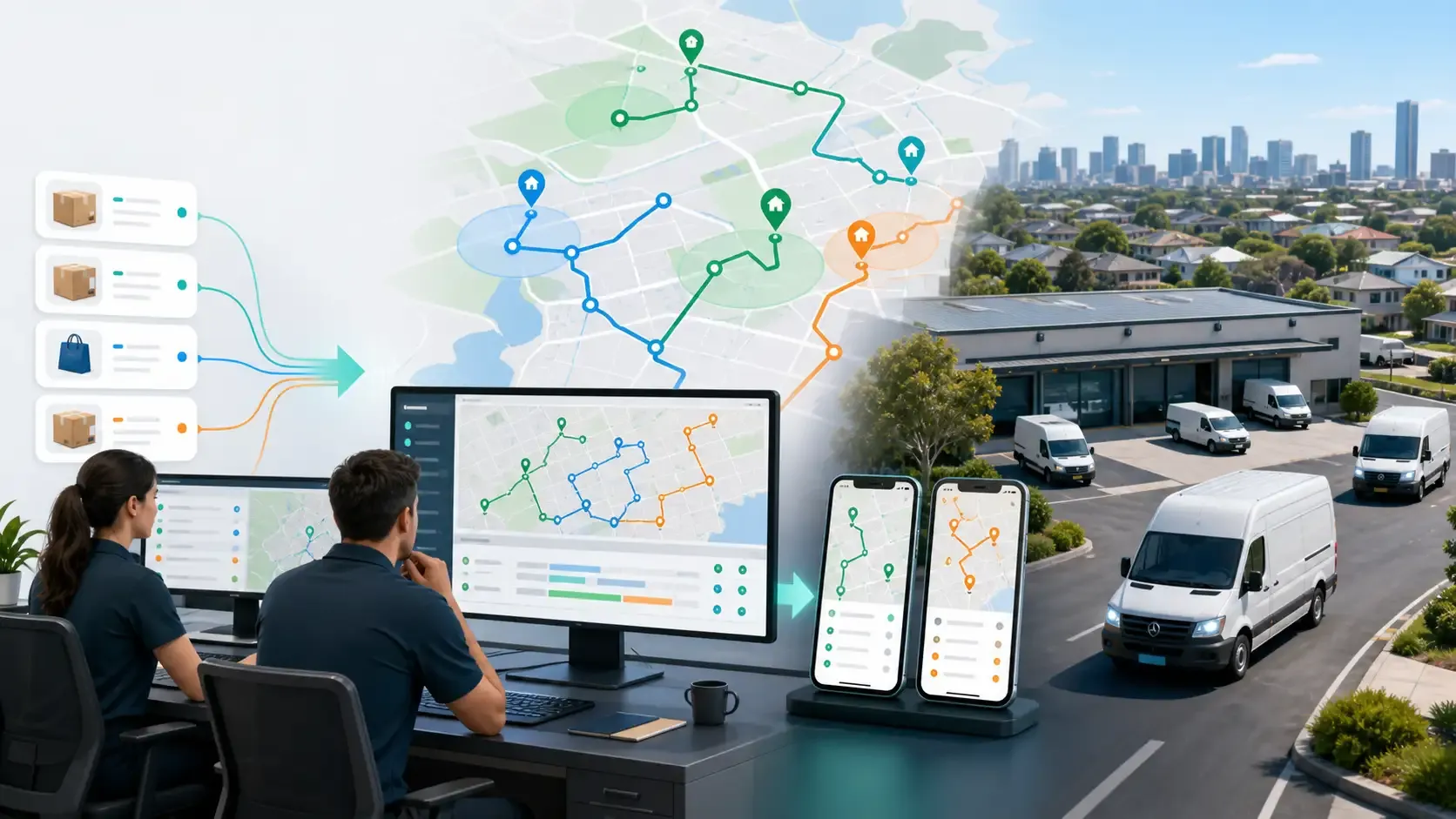
On this page
Courier delivery moves quickly.
Orders arrive, customers expect fast service, drivers need clear work, and dispatchers have to turn a busy day into routes that can actually be completed.
For Australian courier teams, the challenge is not only finding the shortest path between stops. The real challenge is turning daily orders into driver-ready routes without losing important delivery details along the way.
A courier route plan needs clean order data, accurate locations, vehicle and driver context, time windows, route review, assignment, live monitoring, proof of delivery, and reporting. When those pieces are disconnected, dispatchers spend too much time rebuilding the plan manually.
Good delivery route planning helps teams move from orders to route-ready missions, from missions to optimized routes, and from optimized routes to driver-ready work.
Why Courier Route Planning Is Harder Than It Looks
Courier routing can look simple from the outside: collect the orders, put them on a map, and send drivers out.
In reality, dispatchers deal with many moving parts.
Orders may come from different systems. Addresses may be incomplete. Some deliveries may have time windows. Some vehicles may have capacity limits. Drivers may start from different locations. Routes may need to change before dispatch. Customers may call with updates. Managers may want proof that work was completed.
For Australian courier teams, this gets even more complex across busy metro areas, outer suburbs, industrial zones, and regional delivery runs.
A route that looks efficient in a basic map tool may still fail if the driver receives unclear instructions, the vehicle is overloaded, or the customer cannot receive the delivery at that time.
That is why courier teams need delivery route planning that connects the full workflow, not only the map.
Start With Route-Ready Order Data
The first step is turning daily orders into route-ready mission data.
A courier order may include the customer name, address, delivery date, package details, priority, branch, depot, service time, and any customer-specific instructions. If these details are not structured, dispatchers have to clean them manually before planning routes.
Route-ready data should answer:
- Where does the driver need to go?
- When does the customer expect delivery?
- How long might the stop take?
- What vehicle or driver constraints matter?
- Which branch or depot owns the work?
- Is the delivery simple, urgent, bulky, or time-sensitive?
Rouptimize helps teams manage this through delivery mission management software, keeping mission details connected to route planning, dispatch, driver work, and reporting.
When mission data is clean, route planning becomes faster and more reliable.
Import Orders Without Rebuilding the Plan Manually
Many courier teams still receive delivery work through spreadsheets, order exports, warehouse systems, or customer service files.
That is normal. The problem starts when the team has to copy that data into multiple tools before it becomes usable.
A better workflow lets dispatchers import order data once, validate it, review the delivery details, and plan routes from the same operational source.
Rouptimize supports teams that need to import delivery missions from CSV, XLSX, or JSON. This is useful for courier businesses that receive daily delivery lists from multiple sources but still need a consistent route planning workflow.
Clean import reduces manual effort before dispatch and helps prevent mistakes later in the day.
Plan Around Real Courier Constraints
Courier route planning should reflect real delivery constraints.
A route is not just a sequence of addresses. It is work assigned to a driver and vehicle under real operating conditions.
Important courier constraints include:
- Vehicle capacity
- Driver availability
- Depot or branch context
- Delivery time windows
- Stop duration
- Priority deliveries
- Pickup and delivery requirements
- Customer access details
- Proof-of-delivery requirements
If these constraints are ignored, the route may look efficient but become difficult for the driver to complete.
For example, a courier van may not have enough space for bulky orders. A route may cross too much of a city during peak traffic. A customer may require delivery before noon. A driver may need a route that matches a shift window.
Rouptimize’s route optimization software helps teams optimize delivery routes around real operational constraints instead of relying only on manual sequencing.
Vehicle Capacity Can Make or Break the Route
Vehicle capacity is one of the most practical parts of courier route planning.
A courier route can fail before the driver leaves the depot if the assigned vehicle cannot carry the parcels. This is especially important for Australian courier teams handling bulky goods, ecommerce orders, fresh items, business supplies, or mixed parcel sizes.
Good planning should consider both weight and volume. A vehicle may have enough weight capacity but not enough physical space. The reverse can also happen.
Before dispatch, the team should understand:
- Which vehicle is assigned
- What capacity that vehicle has
- Whether the route workload fits
- Whether any parcels need special handling
- Whether the route should be split or reassigned
Rouptimize’s guide to vehicle capacity route planning explains why capacity data should be part of route planning before drivers are assigned.
Dispatchers Need a Route Review Layer
Courier teams should not send optimized routes blindly.
Dispatchers often know details that the system may not fully understand: a loading dock is difficult to access, a customer is slow to receive orders, a road is awkward at a certain time, or a driver is better suited to a specific run.
The best delivery route planning workflow gives dispatchers a chance to review the plan before work is dispatched.
A dispatcher map helps operators review route geometry, mission details, depots, assignments, and stop order before sending work to drivers.
This matters because route optimization should support dispatcher judgement, not replace it.
A good workflow is:
- Import the orders
- Review the mission data
- Optimize the routes
- Inspect the route plan
- Adjust where needed
- Assign drivers and vehicles
- Dispatch driver-ready work
That review step is where software efficiency and operational experience meet.
Driver-Ready Routes Need More Than a Map
A route is not driver-ready just because it has been optimized.
A driver-ready route should give the driver enough context to complete the work without constant back-and-forth with dispatch.
Drivers need to know:
- Which route they are assigned
- Which stops are included
- What order to follow
- Where to navigate next
- What customer details matter
- How to update delivery status
- How to complete proof of delivery
- What to do if a delivery fails
Rouptimize’s driver delivery app helps connect assigned route work with the driver’s field workflow.
For Australian courier teams managing high-volume daily runs, this is important. Every unclear route detail can turn into a phone call, delay, or missed update.
Keep Route Assignment Connected
Route assignment is a key step in moving from route planning to dispatch.
The dispatcher needs to assign the right driver and vehicle to the right route. If this happens outside the planning workflow, there is more room for mistakes.
Common assignment problems include:
- The wrong driver receives a route
- A route is planned but not visible to the driver
- The assigned vehicle does not match the route workload
- Dispatchers lose track of responsibility
- Route changes are not reflected in the driver workflow
Rouptimize’s documentation on how to assign driver and vehicle shows why route assignment should stay connected to dispatch.
Driver-ready routes need clear ownership before the delivery day starts.
Monitor Active Courier Routes
Once drivers are on the road, dispatchers need to know whether the plan is working.
Courier teams often deal with same-day changes, customer calls, traffic delays, delivery exceptions, and route progress questions. Without live visibility, dispatchers may only discover problems after the route is already late.
Live delivery monitoring helps dispatch teams follow active drivers, vehicles, mission status, and route progress.
The goal is not to watch every movement. The goal is to make exceptions visible early enough to act.
For Australian couriers working across metro congestion and outer-suburban travel, live monitoring can help dispatchers focus on the routes that need attention instead of chasing every driver manually.
Proof of Delivery Completes the Workflow
Courier work is not complete until the delivery is confirmed.
Proof of delivery helps operations teams verify that a mission was completed and gives managers a record to review if a customer dispute appears later.
A lightweight proof workflow is especially useful for couriers because drivers need to move quickly from one stop to the next.
Rouptimize’s proof of delivery software supports code-based proof so completion can stay tied to the mission record.
This keeps the delivery workflow simple for drivers while giving the operations team better visibility into completed work.
Use Reports to Improve the Next Route Plan
Delivery route planning should improve over time.
After the route is complete, managers should be able to review what happened. Which routes finished late? Which drivers had too much work? Which delivery areas caused delays? Which stops had proof gaps? Which branches had repeated exceptions?
Rouptimize’s delivery reports and analytics help teams compare planned work, completed work, driver activity, route performance, and operational bottlenecks.
This creates a practical improvement loop:
- Import courier orders
- Plan routes
- Assign drivers
- Dispatch work
- Monitor active routes
- Verify delivery completion
- Review reports
- Improve the next plan
That loop is where courier route planning becomes stronger over time.
What Australian Couriers Should Look For
When evaluating delivery route planning software, Australian courier teams should look for more than a route generator.
The system should support the full daily workflow from order intake to completed delivery.
Important capabilities include:
- Mission import
- Route optimization
- Vehicle capacity planning
- Dispatcher map review
- Driver and vehicle assignment
- Driver mobile app
- Live delivery monitoring
- Proof of delivery
- Reports and analytics
- Branch and depot context
Rouptimize’s courier route planning software is designed to support dispatch teams that need to move from delivery work to route-ready driver assignments without rebuilding the plan in separate tools.
Common Mistakes in Courier Route Planning
Courier teams often run into the same planning problems.
They plan from incomplete data. They rely too heavily on manual sequencing. They separate dispatch from driver assignment. They send drivers routes without enough mission context. They review performance too late to improve the next day.
These problems create avoidable cost.
A better approach is to treat route planning as a connected workflow. Orders become missions. Missions become routes. Routes become driver assignments. Driver assignments become active work. Active work becomes reports. Reports improve the next dispatch cycle.
This is how courier teams turn daily delivery pressure into a more controlled operation.
Conclusion: Driver-Ready Routes Start With Connected Planning
Delivery route planning for Australian couriers is about more than putting stops in order.
It is about turning daily orders into clean mission data, optimizing routes around real constraints, reviewing the plan before dispatch, assigning the right drivers and vehicles, giving drivers clear mobile context, monitoring active work, verifying completion, and learning from reports.
The best courier route planning workflow connects every step from order to driver-ready route.
Rouptimize helps delivery teams manage this workflow across mission management, route optimization, dispatcher maps, driver apps, live monitoring, proof of delivery, and reporting.
Start free with Rouptimize
Written by
Results-oriented and visionary CEO with a passion for innovation and a track record of transforming startups into industry leaders. Seeking a leadership role in a dynamic startup environment where I can leverage my strategic acumen, entrepreneurial spirit, and hands-on experience to drive growth, build high-performing teams, and deliver unparalleled value to customers. Committed to fostering a culture of creativity, adaptability, and sustainable success.
Operations • Management • Route Optimization • Product Management • Logistics • Problem Solving
FAQ
What is delivery route planning for couriers?
Delivery route planning for couriers is the process of turning daily orders into practical routes that drivers can complete. It includes order data, route sequencing, vehicle capacity, driver assignment, dispatch, monitoring, proof of delivery, and reporting.
Why is route planning important for Australian courier teams?
Australian courier teams often manage metro congestion, outer-suburban travel, regional routes, tight delivery windows, and rising delivery costs. Better route planning helps dispatchers create routes that are easier to review, assign, and complete.
What makes a route driver-ready?
A driver-ready route includes the assigned driver, vehicle, stop sequence, mission details, customer information, navigation context, status workflow, and proof-of-delivery steps.
How does route optimization help couriers?
Route optimization helps couriers sequence delivery work around real constraints such as location, vehicle capacity, driver availability, depots, and customer time windows.
Why is mission import important for courier route planning?
Mission import helps teams turn order data from spreadsheets, warehouse systems, or ecommerce exports into structured route-ready delivery work.
Should dispatchers review optimized courier routes?
Yes. Dispatchers should review optimized routes because local knowledge, customer details, driver availability, and route exceptions can affect the final plan.
How does live monitoring support courier dispatch?
Live monitoring helps dispatchers see active route progress, driver context, mission status, and exceptions during the delivery day.
How can reports improve courier route planning?
Reports help managers compare planned routes with completed work, identify bottlenecks, review driver activity, and improve the next dispatch cycle.